09 September 2010
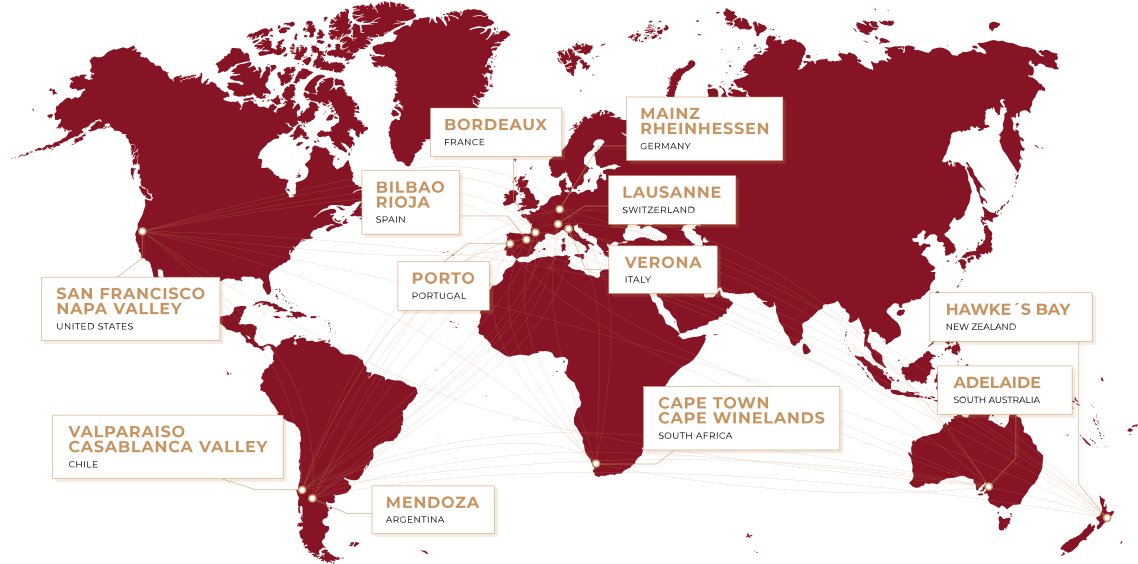
Great Wine Capitals
...the global connection of renowned wine tourism regions
07 September 2010
Rioja celebrates two wine festivals in September


In August and September each Spanish wine region celebrates its harvest festival.  In the Rioja region, wine is so important that we celebrate it twice!  The Rioja wine district is located in three comunidades autónomas, or semi-autonomous states:  La Rioja, the Basque Country and Navarra.  Both La Rioja and the Basque Country organize Rioja wine festivals, so it’s possible to celebrate the 2010 harvest during most of the second half of September.


The 17th annual Rioja Alavesa Harvest Festival will take place on Sunday, September 12 in the medieval walled village of Laguardia.  Following the blessing of the first juice pressed from grapes from the harvest, visitors can buy tasting vouchers and a glass to sample wines from each of the wine villages in Rioja Alavesa at stands located around the village. Basque dance and music groups will add local color to the day’s activities followed by an outdoor lunch forparticipants in the day’s activities.


This year a special ceremony will take place: the twinning of ‘bonito del norte’ (tuna fish with a quality label caught by the Basque fishing fleet) with Rioja Alavesa wine.


The 54th annual San Mateo Rioja harvest festival will take place in Logroño from September 18th to the 25th.  The festival features rock and folk music concerts, wine tastings, Riojan food specialties prepared by the peñas (social clubs whose mission is to make sure that there is always something exciting happening during the festival), bullfights and nightly fireworks.


September 21, St. Matthew’s Day, is the highlight of the festival with the crushing of the first grapes from the harvest, the blessing of the grape juice and a children’s parade where each village in La Rioja sends two representatives dressed in the typical costume of the village to offer grapes to the Virgin of Valvanera, the patron saint of La Rioja.


During the week-long festival, the bars and restaurants in Logroño are packed with locals and visitors enjoying Riojan and Basque cuisine, all watered down with Rioja wine.  


Photos, left to right:


- the poster of the twinning of 'bonito del norte' and Rioja Alavesa wine

- the poster announcing the 17th annual Rioja Alavesa Wine Festival

- the Urdiales brothers crushing the first grapes from the harvest

- the ceremony offering the first juice to the Virgin of Valvanera


Posted by 07 September 2010
0 comments | leave comment | share this
Tags: Rioja harvest festival, Rioja Alavesa harvest festival
31 August 2010
Douro Valley in the running for 7 Wonders of Nature


The Douro Valley, a place of stunning landscapes famous worldwide as the wine-making region of the unique Port Wine, is the only place in Portugal among the finalists of the voting for the New 7 Wonders of Nature of the World .


The region famous for its terraces, the oldest demarcated region in the world and home of the famous Port Wine, attracts more and more tourists each year and now hosts some of the most exciting and exquisite hotels of Portugal.


The Douro Valley is also the birthplace of one of the strongest and most outspoken of Portuguese writers, Miguel Torga.


The Douro Valley as one of the most beautiful natural spots in Portugal, is a must go destination!


A momentum to celebrate Nature!


New7Wonders tour is on the move for the final voting, marking the change of nature of the competition from man-made structures, in 2007, to natural places, in 2010. Voting will continue throughout 2010 and into 2011.


The Portuguese edition is in the final countdown. Out of the top 21 nominees voted so far from the 200 candidates, New7Wonders Portugal will choose the seven finalists, next 11 September, 1n the Azores Islands, where the ceremony is based. The wonders themselves will be chosen by an estimated 250 000 votes


There is also another feature to mention. On this UN International Year of Biodiversity this campaign also celebrates the value of biodiversity on our lives.


Discover here the Portuguese wine routes, the Douro valley, a UNESCO world heritage site, the excellent wines, learn about the oldest demarcated wine region and lose yourself in the stunning landscapes that took centuries to perfect!


The e-voting ends on the 7th of September, on http://www.7maravilhas.sapo.pt/

Posted by 31 August 2010
0 comments | leave comment | share this
Tags: Douro Valley, New 7 Wonders Portugal
17 August 2010
Mainz Wine Market-August 26-29 and September 2-5, 2010

It is supposed to be the most beautiful wine festival in Mainz. Every year Mainz’s Rosengarten and Volkspark with its unique ambience are the sites for the Wine Market. The last weekend in August and the first weekend in September white wines, red wines and rosés from the previous year are offered as well as wines from earlier vintages. It’s a great chance to share one's love for wine with hundreds of winemakers and other wine connoisseurs or simply enjoy a lovely evenning right in the heart of Mainz' biggest park, the Stadtpark.

Traditionally the wine market is opened the first day at 6 P.M. by Lord Mayor Jens Beutel and the incumbent Rheinhessen Wine Queen Sina Listmann. Right from the start the so called “Schlenderweinprobe” was a big success. After buying the ticket for just 9.50 € you can stroll around and take a break whereever you like and taste up to eight different wines at several booths. At the “Mainz Square” you can enjoy live music every day or just take a walk at the artists' fair at the Rosengarten and discover hand-made hats, fancy jewellery or handwork made of wood, glass or clay.

Since Mainz and Rheinhessen became members of the Great Wine Capitals Global Network in 2008 every year one network partner is presented at the wine market. In 2009 wines from South Africa were highly appreciated by all visiters. This year's special guest at the wine market is Argentina with wines from Mendoza. Together with some gastronomic specialities and some show events first of all the wines from Argentina will surely convince all visitors right in the heart of the Rosengarten. Special offer is a blind tasting of Argentinian and local wines taking place Saturdays from 3 P.M. to 6 P.M. and Sundays 12 o'clock until 4 P.M.

Being the highlight of the wine events of Mainz the city boasts no fewer than seven major wine events starting in March with the Wine Tasting Days in Mainz-Hechtsheim and Johannisnacht (St. John´s Night) in town in June; the Wine Fest at the Kirchenstueck (Mainz-Hechtsheim); the Wine Fest at Mainz-Ebersheim; and the Vine-blossom Fest at Mainz-Laubenheim, all in July. Mainz-Hechtsheim hosts the Vintners‘ Days festival in September and the Rheinhessen Wine Forum takes place in October at the Electoral Palace.

And a last hint: I you would like to enjoy one last small glass of wine before leaving just order a „Piffche“ That's just 0,1 l of wine or 0,176 pint and can be drunk in less than a whistle.

Posted by 17 August 2010
0 comments | leave comment | share this
Tags: Mainz, Mainz Wine Market
03 August 2010
The North Canterbury Food and Wine Trail


Christchurch and the surrounding Canterbury region represent the heart of the South Island, and the best experiences New Zealand has to offer.

Just outside of Christchurch, Waipara Valley, New Zealand's fastest-growing wine region , helped secure the country's bid to join the prestigious Great Wine Capitals Global Network. Wine-lovers will savour the journey, and want to spend a day exploring the area’s over 80 vineyards, from a wild pie at the Mud House Winery, to a memorable visit with the Donaldson family of Pegasus Bay.  

The North Canterbury Food and Wine Trail is a wine-lover’s dream come true – there’s so much you can see in two days, and even more if time permits. Here’s a suggested itinerary to take in the wine valley’s highlights.

 Day 1, Christchurch to Waimakariri  

Prior to leaving Christchurch, get the North Canterbury Food & Wine Trail map available at the Christchurch i-Site Visitor Centre located in Cathedral Square. This map showcases the best cafes, restaurants and wineries to visit along  the way. 

Drive to Springfield and experience an iconic New Zealand attraction - the Alpine Jet.   Travel to Oxford for lunch at the famous Seagars at Oxford Café & Cooking School. Enjoy wandering  through the town's boutique stores, and then head to Okuku Country Estate for afternoon tea and a tour of the historic house and garden. If you stay the night, indulge in dinner of local organic produce, and a swim and spa in the indoor facility. 

Day 2, Waipara Valley

Perhaps the area's best-kept secret is Karikaas Cheese - taste their award-winning cheeses at this boutique countryside factory, located on the outskirts of Rangiora. 

Then continue to Waipara Valley, where you are spoiled for choice in terms of wineries . We highly recommend:

  • Pegasus Bay Winery was founded by the Donaldson family, pioneers of local grape growing and wine making. Originally from Prague, Daniel Schuster's own New Zealand Winery is born out of his 25 years of international winemaking experience.

  • The Mud House Winery and Café offers creative cuisine and a warm, friendly atmosphere.  

Check into the five-star, eco-friendly Claremont Country Estate for the night, built in 1866 from hand-cut limestone, one of Canterbury's truly authentic homesteads. Enjoy dinner surrounded by acres of delightful, manicured flowered gardens and fruit trees. 

Consider taking a memorable Land Rover Safari at Claremont, before heading back to Christchurch. Or if you have more time, head north to Hanmer Springs and Kaikoura.  The second boasts the Kaikoura Winery,  where the main reception building is sited on the edge of a limestone cliff looking out on the larger Kaikoura landscape. 

Okuku Country Estate

Situated amongst magnificent parkland on 100 acres in the North Canterbury foothills, bordered by the Ashley River and includes a farm, natural bush, magnificent woodland gardens, lawn tennis court, indoor swimming pool and terrace with outdoor bar and barbecue. 

Seagars at Oxford

Seagars at Oxford is Jo's dream to share her passion for New Zealand food & wine and provide the tools to help create great meals with minimum effort for maximum effect. 

Pegasus Bay Winery

A very impressive winery and their restaurant stands out as one of the best places to eat in Canterbury. Whether in front of a roaring fire in winter, or outdoors on a hot summer day, you will find delicious food, a great welcome and some stunning wines.

Photos credits:

"Pegasus Bay Winery" and "Mudhouse Winery and Café"
Posted by 03 August 2010
0 comments | leave comment | share this
Tags: North Canterbury Food and Wine Trail, Christchurch
30 July 2010
A real welcome for tourists in the Cape


I enjoyed visits the Cape Winelands back in 1998 and 2000, but sadly haven’t yet managed to make a return visit. However, I don’t need to look back at my photos from those trips to remember the fantastic images, for the Cape is high on the list of the most beautiful wine regions in the world. Even ten years ago, it was obvious that the South African wine industry was gearing itself up well to wine tourism.

 
Back then, touring around in the surroundings of the dramatic mountains, combined with the distinctive Cape Dutch architecture, I could see old wineries re-building, architect-designed wineries emerging, winery restaurants appearing; Cape Town had well-stocked wine shops that offered shipping back home; and most importantly of all, the wine producers were generous with both their time and their ever-improving wines, wanting the world to learn about and experience the best they had to offer. Since then, wine tourism has gone from strength to strength.
 
As we saw from the recent football World Cup, South Africa is well geared up for tourism, and the country’s main vineyard areas are all in easy reach (20 minutes to two hours) of Cape Town, which is a keen member of Great Wine Capitals.
 
One of the most amazing “complaints” I read about the World Cup was that some visitors were disappointed by cool and rainy weather, having not taken into account that this was winter and South Africa is not equatorial! The very fact that the Cape in particular has cooling winds coming in from the Indian and Atlantic oceans is a key to why they produce some excellent wines. Combine this with a wide range of suitable vine-growing soils, micro-climates influenced by the surrounding mountains and an expertise in matching grape variety with terroir that has developed greatly in the past 20 years, and the potential is huge.
 
South Africa has had designated wine routes for many years, and by far the largest in terms of winery membership is Stellenbosch, which is also the oldest, dating back to 1971. Stellenbosch is the name, not just of a well-known University town, one of the earliest towns to have been settled in South Africa, but also of the country’s best known wine region. Today for tourism purposes, Stellenbosch is divided up into five wine routes, sensibly not by appellation, but by routes that are logical for wine tourists to follow. (Something dear to my heart, as we’ve taken that brave step with the way we divide many of the French wine regions on Wine Travel Guides).
 
Over 140 wineries are part of the Stellenbosch American Express® Wine Routes programme, gaining both in public relations terms and in cellar door sales. The programme also helps encourage visitors to indulge in other attractions wineries offer, such as restaurants, specialist non-wine products (e.g. cheese or olive oil) or complementary activities (e.g. bird watching, fly-fishing). Nearly all the wineries charge a small amount for tastings, reimbursed on purchase and they will organise shipping overseas. Gardens alongside the vineyards are gaining in popularity to support the wine industry’s laudable initiative to set aside more areas as non-planting land for vineyards, encouraging South Africa’s natural biodiversity. In this area known as the Cape Floral Kingdom, the emphasis is on planting only native species and encouraging the re-introduction of local fauna and flora.
 
The best time of year to visit the South African winelands is between November and May, with spring (November) and Autumn (April/May) being not only the cheapest time to travel but also the most interesting times to see the vineyards and wineries too. If, however, you do like the idea of wine touring during the Northern Hemisphere’s main summer holiday period of July/August, don’t worry, the wineries keep their doors wide open, and what’s more Stellenbosch holds a huge, annual 4-day festival normally towards the end of July. In 2010, it was brought forward to early July to coincide with the World Cup and to attract international tourists. Instead of being held in the town, it became a travelling festival, with shuttle buses taking visitors between 60 wineries. Next year this great wine event will once again be held in one venue in the town from 28 - 31 July 2011.
 
As with all travel, advance planning can make all the difference and there are excellent resources available to research your trip both on-line and in print. Do check out Wines of South Africa’s very informative website, and also the Stellenbosch Wine Routes own website, which is very comprehensive and easy to navigate. Thanks are due to these last organisations for the photos on this post.
 
When I travelled a decade ago in South Africa, I was always armed with the latest annual edition of John Platter South African Wine Guide, although the book has always been notoriously difficult to find until you’re out there. It remains an excellent guide to wines and wineries and has some decent wine touring information too.


More detailed information for wine tourists travelling all over the Cape wine regions can be found in The Essential Guide to South African Wines 2nd edition by Elmari Swart and Izak Smit, published in 2009. Attractively laid out, the heart of the book divides the wine regions into “Pockets” according to their terroir, again another way of splitting up regions in a logical way for visitors, not necessarily by appellation.
 
Wineries include most of the well known names, although the publication sought sponsorship from these to help with costs. A few pointers to local restaurants and accommodation are included. There are clear maps and in an innovative move, GPS information can be downloaded to your SatNav from the publisher’s website. The book includes useful and well-written introductory background chapters about the history, climate, geology, grapes and wine styles, plus some good basics on wine tasting and what to expect when wine touring in South Africa.


At least if you plan your wine tour in the beautiful wine country of South Africa next year, you are more likely to hear the sound of exotic bird song than of vuvuzelas.
 
By Wink Lorch, Wine Travel Guides
The original version of this blog post first appeared on http://blog.winetravelguides.com/
 
Photo credits:
Pincushion Protea ©Erica Moodie/WOSA
Stellenbosch Wine Festival picnic and tasting ©Stellenbosch Wine Routes
Posted by Wink Lorch 30 July 2010
0 comments | leave comment | share this
Tags: Wine tourism; Cape Town, Wine Tours, Wine Region, South Africa, Cape Wineland, Biodiversi
14 July 2010
Rioja winery architecture - where form meets function


Architects have always been used to design wineries, but until a few years ago, the architect’s job was mainly functional:  to assure the most efficient way to move grapes and wine through the winery, with form taking a secondary role.


In Rioja, beginning in the 1970s, a number of winery owners have paid more attention to design as a means of drawing the attention of consumers and the press to the wineries.


Bodegas Olarra, located just outside Logroño, was a trendsetter in 1973, with its “Y” shaped floor plan and 111 hexagonal egg-box domes. Then in the early 1990s, Julio Faustino Martínez, owner of the Faustino group of wineries, created Bodegas Campillo in Laguardia, with its spiral staircase that forms the backbone of the winery.


Other wineries followed suit, beginning with Domecq Bodegas who built Bodegas Juan Alcorta, recently renamed Bodegas Campo Viejo in honor of its flagship brand, located on the top of a hill near Logroño but mainly underground except for its office building and wine shop, and Bodegas Ysios, near Laguardia with its shimmering titanium roof reminiscent of waves on the ocean.


Viña Real, part of the CVNE group of wineries, also located near Laguardia features two barrel ageing cellars excavated from the side of a hill and a unique barrel-shaped vinification plant.


In Samaniego, Bodegas Baigorri uses gravity to move grapes and wine from the top to the bottom of its multilayered winery topped by a glass-enclosed viewing area looking out on one side to the majestic Cantabrian mountain range and the other side across the Ebro valley.


One of Rioja’s most historic wineries from the 19th century has also gotten into the act: Bodegas López de Heredia, arguably the most traditional winery in Rioja commissioned Iraqi-.born Zaha Hadid to design an avant-garde flask-shaped, glass and aluminum tasting room and wine boutique.


Two recent additions to this group of spectacular wineries, Bodegas Darien, east of Logroño and Bodegas Antión in Elciego, were designed by Riojan architect Jesús Marino Pascual.


Wineries are not the only buildings that grace the Riojan landscape. Bodegas Marqués de Riscal, well-known for innovation in the 1860s for successfully inteoducing Bordeaux winemaking and ageing methods to Rioja, convinced Canadian architect Frank Gehry to design a sweeping, titanium roofed hotel next to the winery, while in Villabuena de Álava, the Hotel Viura, opened in March 2010 resembles multicolored building blocks superimposed on one another.


Many of these wineries and hotels have won Best Of awards from the Great Wine Capitals and all of them except Bodegas Antión are open to the public.


The next time you visit Rioja, be sure to visit some or all of these buildings that have helped make Rioja one of the most popular wine tourism destinations in the world.


Tom Perry (Inside Rioja)


Pictures:


Bodegas Darien, Hotel Marqués de Riscal


Posted by 14 July 2010
1 comments | leave comment | share this
Tags: Rioja winery architecture
07 July 2010
Health & Wellness Within the Legendary Napa Valley


The Napa Valley Invites Visitors to Discover Its Sportier Side


The Napa Valley is legendary as America’s preeminent wine, food, and wellness destination. Its authentic country setting offers diverse recreational amenities to satisfy outdoor enthusiasts seeking open-air activity between - and even paired with - The Valley’s culinary wonders. Whether one prefers a relaxed communing with nature, or a vigorous athletic endeavor, The Napa Valley offers many options to enjoy its natural bounty in a healthful and inspiring fashion. Following are recommendations of sporting pursuits visitors can add to their next Napa Valley travel itinerary…


At pristine Bothe-Napa Valley State Park, visitors are greeted by stands of coastal redwoods that give way to mixed evergreen riparian forest. Here one will find the same indigenous flora and fauna early settlers encountered in The Napa Valley.  Just a 15 minute drive from either St. Helena or Calistoga, the park offers camping, swimming, horseback riding and hiking trails that wind through forests of coastal redwoods, Douglas-fir, tanoak and madrone. On a leisurely stroll through Ritchey Canyon on the Redwood Trail, visitors will be drawn along by the sounds of water splashing down the rocky creek bed to a delightful spot perfect for a picnic. In addition to Bothe-Napa Valley, the State of California also operates Robert Louis Stevenson State Park and one state historical park, Bale Grist Mill.  Plus at Skyline Wilderness Park, visitors can enjoy a large equestrian, hiking, and limited camping park featuring abundant wildlife and native wildflowers.


Another delightful local wonder is the Old Faithful Geyser of California. One of only three geysers in the world sporting the “Old Faithful” designation, this geyser lifts a glorious, thousand-gallon tower of water into the sky at regular intervals.  Guests can tote their own picnic or enjoy a memorable meal in nearby downtown Calistoga. Old Faithful Geyser also features a petting zoo with Tennessee Fainting Goats, Jacob’s Four-Horn Sheep, and Guard Llamas—all of which are great additions for one’s photo memory book.


Lake Berryessa is one of California’s largest manmade, freshwater lakes.  A recreation destination for those that appreciate activity in, on, and above the water, the Lake offers anglers both cold and warm water species, including large-mouth bass, rainbow trout, catfish, crappie and bluegill. Water sports and boating are also plentiful. Plus, hiking trails along the grassy hills surrounding the Lake are speckled with oak and Manzanita trees, and provide excellent opportunities to view eagles, hawks, songbirds and deer while hiking.


With so many charming places to shop, eat and drink within The Valley’s various communities, the best way to explore their downtown areas is often by bicycle.  Eco-conscious hotels such as Solage Calistoga, Auberge du Soleil, and Villagio Inn among others, offer bicycle rentals to guests.  Beyond resort grounds and downtown areas, many parks have long-winding bicycle trails that visitors find appealing. The Bardessono, The Valley’s leading “green” hotel with its recent Platinum LEED® certification, offers a Biking and Wine Tasting package that includes bicycles, a map of the wineries, and picnic items for an unforgettable day in The Napa Valley wine country.  There are also several independent bicycle tour operators that can organize packages or daily bike rentals.


The Napa Valley is also home to several outstanding golf courses. The Chardonnay Golf Club, Eagle Vines Golf Club, Vintner’s Golf Club and Napa Municipal course each welcome visitors. Overnight guests at Silverado Resort can challenge themselves on their two 18-hole championship golf courses.  A world-class destination getaway, Silverado also features a full service spa, 10 swimming pools and 17 tennis courts, as well as hiking and biking trails.


At Meadowood Napa Valley guests may test their skills in a spirited game of croquet - the lawn sport that has been an English staple since the 1860s. The property offers two world-champion-caliber croquet lawns and also offers the finest full-time teaching facility for croquet in the country. Beyond croquet, Meadowood guests enjoy a complete sports and wellness experience with cardio, stretch and strength classes, a tranquil nine-hole walking golf course and resident golf pro, seven tennis courts and a resident tennis pro, swimming, hiking and a full range of spa services.


The Napa River is a jewel of The Napa Valley and perfect for kayaking, canoeing and boating through such outfitters as Kayak Napa Valley. For a workout on the water, join their team of escorts, or paddle solo to spy flocks of pelicans, mallards, green-winged teals, mergansers, wood ducks, herons, egrets, kingfishers, rails and grebes as well as the endangered clapper rail. Mink, muskrat, raccoons, deer, gray fox and bobcat also live in this riparian habitat.


After a day of hiking, biking and more, tired muscles will welcome the opportunity to sink into Calistoga’s Roman Spa Hot Springs Resort experience.  At this relaxing escape, guests can swim in a natural hot springs mineral pool, relax on the sun deck underneath the California sunshine, and rejuvenate in their famous Calistoga mud bath, which uses natural volcanic mud to impart therapeutic benefits.


If the sky’s the limit when it comes to outdoor adventure in The Napa Valley, why not enjoy a hot air balloon ride? Reservations for this uplifting open-air adventure can be booked at the Napa Valley Marriott Hotel and Spa through their “Balloon Blowout Package.”  This limited-time package includes overnight hotel accommodations for standard and concierge level rooms, wine tasting passes for two, and a fabulous balloon ride experience. There are also a half dozen independent outfitters, such as Balloons Above The Valley, through whom ballooning arrangements can be made.


more about Napa Valley

America’s legendary wine, food, arts and wellness destination, The Napa Valley is home to legendary entrepreneurs who showed the world that the art of winemaking had crossed continents. The very word Napa stands for ‘Land of Plenty’, the original meaning given to the region by its first inhabitants, the Wappo Indians. Voted the World’s #1 Food & Wine Destination in the recent 2010 TripAdvisor® Travelers' Choice® Awards, The Napa Valley is Internationally recognized as one of only nine “Great Wine Capitals” and is prized for its natural beauty, phenomenal culinary scene, world-class accommodations, robust arts scene, and one-of-a-kind wellness experiences including the region’s famed spas, mud baths and natural geo-thermal springs. For more information about The Napa Valley visit www.LegendaryNapaValley.com.


- Jennifer Johnstone

  Napa Valley Destination Council


 Photos courtesy of the NVDC

Posted by 07 July 2010
0 comments | leave comment | share this
Tags: Napa Valley, wellness destinations
29 June 2010
The Wine Fund launches new tasting courses


If you plan to visit Mendoza, the wine capital of Argentina, you will no doubt want to visit several wineries, or ‘bodegas’ as they’re called in Spanish.  But why not go one step further and enroll in one of the one-evening wine courses that the Mendoza Wine Fund runs throughout the year?


Since 2002, the Fondo Vitivinícola Mendoza (Mendoza Wine Fund), a member of the local Great Wine Capitals network, carries on the "Cycle of Wine and Food & Wine Tasting". These courses, aimed at the general public and require no previous knowledge of wine-related topics, are held permanently in the Enoteca, a famous wine place in Mendoza.

The objective is to introduce participants to the culture of wine to help them to discover and enjoy the exciting world of this cultural drink of Argentina and experience the pleasures of wine and food pairing.

The courses are designed by renowned sommeliers, with a great track record and extensive experience in teaching how to taste.

This is a great opportunity to meet the world of feelings of Argentina's wine culture and an excellent opportunity to bring pleasure and knowledge, closer to wine and multiplying your message.


The proposal for 2010


During the first half of 2010 21 courses were dictated, attended by more than 600 wine lovers. The options were diverse including tasting courses, wine tastings and food pairings, sensory analysis, Argentinean wine regions, wine and olive oil, and cheese and wine.

For the second half of the year, the Wine Fund plans to offer 18 courses according to the following schedule:


- Wine tasting, levels I, II and III

- Oaked and non-oaked wine

- Comparative tasting and food pairing: Malbec vs. Cabernet Sauvignon, Chardonnay vs. Sauvignon Blanc

- Wine tasting and food pairing: what every good sommelier should know

- Dessert wines and desserts

- Sparkling wine and citrus cakes

- Wine and ice cream

- Cocktails with sparkling wines


These one-day courses are held in the evening for two to four hours and require no prior wine knowledge (but Spanish is useful as the courses are given in that language.


For further information, contact Gabriela Quinteros at gabriela@fondovitivinicola.com.ar


Posted by 29 June 2010
1 comments | leave comment | share this
Tags: Mendoza, Fondo Vitivinícola Mendoza, Mendoza Wine Fund
23 June 2010
The best Florentine chefs together for a special dinner


Italo Bassi from Enoteca Pinchiorri, Florence

Andrea Bianchini from Bottega del Cioccolato, Florence

Vito Mollica from Four Seasons Hotel, Florence

Saverio Sbaragli from Luxory Hotel Il Salviatino, Florence

Marco Stabile from Ristorante Le Ore D'Aria, Florence

Maria Salcuni, Cristian Santandrea, Maria Probst from Ristorante La Tenda Rossa, Cerbaia - Florence

 These are the six top names of Florentine cuisine that, thanks to a unique occasion of collaboration, will prepare a special dinner for the presentation of Wine Town Firenze 2010 event.

 Are you wondering what’s Wine Town Firenze?

One hundred of the most excellent Italian wineries are involved in the Wine Town Firenze 2010 project (www.winetownfirenze.com), which, from September 30th to October 3rd, will take place in Florence city center, as a huge open air wine tasting.

The wineries will be set in unconventional locations, such as historical buildings, cloisters, and marvelous places of one of the most beautiful cities in the world.

So 100 spaces for 100 wineries, and at the same time 100 live shows! The city will turn into an explosion of liveliness!

The event is meant to offer very high quality wines, thanks to the selection made by the professionals of the AIS, Italian Sommelier Association (www.sommelier.it) . 

It is addressed to those people who love wine, and want to deepen their knowledge of its history and its evolution: sommeliers, professional market operators, gourmest, connoisseurs, journalists, and everybody looking for the Italian art of living.

Visitors will meet big names of Italian wine, and taste our territory’s excellence during such a vibrant event.

 All the secrets – and I guarantee there are a lot! – about this happening will be unveiled during the Cena dei Mille,  a dinner for 1000 people that will be held on the first days of September in the wonderful Boboli garden, that is to say the “backyard” of Palazzo Pitti, one of the Medici family estates. The price to participate to this dinner is 90 € each; the dinner proceeds will be donated to the Florence children’s hospital Meyer. You will find info on the official website very soon!

 Booking: Florence Box Office, Via Alamanni 39. Tel. +39 055 210804      e-mail: info@boxofficetoscana.it

Posted by 23 June 2010
0 comments | leave comment | share this
Tags: Firenze, Wine Town Firenze 2010
13 June 2010
St. John's Night Festival - Mainz celebrates its most famous son


June 25th to 28th 2010


It is the climax of the festival season in Mainz and supposed to be one of the largest festivals in Germany. every year on the last weekend of June the city of Mainz celebrates its most famous son: Johannes Gutenberg. He invented  printing with movable letters in the 15th century and was elected to be the “Man of the Millennium” by  Time magazine in 1998.


In remembrance to this important innovation launched by this great son of Mainz, the initiation ceremony for printers, the dunking of printing apprentices is an integral part of St. John´s Night Festival and takes place in the direct vicinity of the Gutenberg Museum, at Liebfrauenplatz. By this the sins of the years of apprenticeship and the lead dust gets symbolically washed off the young pressmen.


The Johannis Book Fair from Saturday to Monday at Ballplatz and Schillerplatz, by the way, Germany's largest antiquarian book fair, as well as the artists' fair by the Rhine have long since become firmly established, attracting visitors from near and far. On Saturday and Sunday calligraphers, papermakers and mediaeval illustrators present their skills at Ballplatz.


Four days long, music, theatre and folklore groups, itinerant entertainers and marching bands make their mark in the city centre. Musical and artistic performances are given continuously on six stages within the festival area. Don´t miss the cabaret artists and their program at Ballplatz or the music performances at Schillerplatz, Liebfrauenplatz and Jockel-Fuchs-Platz. It is also a festival for gourmets and bon vivants. The top chefs from Mainz and Rheinhessen please their guests at the Weintor near the banks of the river Rhine with exquisite food and great wines in a pleasant atmosphere. Local winemakers offer their wines at Leichhof and on the market. The Hilton Mainz offers international food along the artists´ fair by the river Rhine.


Every year a breathtaking firework display over the Rhine forms the festive close on Monday evening after 4 days and 3 nights. Mainz – Live it!

Posted by 13 June 2010
0 comments | leave comment | share this
Tags: Johannesnacht, St. John's Night, Gutenberg
09 June 2010
In June be part of Porto's festivities


It is in June that Porto becomes even more alive, preparing for the São João night from the beginning of the month. The highlight of this season is, without any doubt, the night from 23 to 24 June, with the huge popular festival of São João. 

The night of the 23 June hosts fun and joy and sensuality. It is the happiest night of the year in which the streets welcome hundreds of people celebrating the saint who favours lovers. During the popular festivities, there are cultural and entertaining events, "rusgas" – a popular kind of dancing on the street, and the famous Barcos Rabelos Race, exhibiting the typical boats formerly used to navigate on the Douro River along 1,5 km, from the Douro mouth to the Luís I Bridge, at Ribeira.

Competition is also part of the celebration, with the traditional São João Run, as well as the competitions of the "cascatas" (typical outdoor decoration), the shop windows and popular poetry.

On the city centre street sellers shout out loud to sell their traditional “manjericos” (basil), carnations, lemon balm, “alho-porro” or São João leek, as well as modern plastic hammers, which you must have to be able to friendly hit your fellow neighbours on this São João night.


Experience São João as locals do!

The streets are brightly decorated and filled with sellers of appetizers, street dancing and play, leading the people to celebrate São João surrounded by fun, familiarity, friendship and joy. Jump over the bonfires and dance as if the world would end this very night! Go to every party, every dance, letting emotion lead your way. Start at Fontaínhas, pass through the city centre and follow to Ribeira to stop only at Foz. Don’t finish your night without a dive into the cold Atlantic waters to receive all the São João magic.

Live this festival and carry out all the rituals.

Don’t’ forget to pay a visit to the city’s churches that host the Porto inhabitants’ dearest saint.

Porto dresses up just for you, making sure you live an unforgettable weekend discovering and enjoying the city.


Come and join us for a wonderful time. Porto awaits you!


Check the complete programme at www.visitporto.travel/saojoao/


Posted by 09 June 2010
0 comments | leave comment | share this
Tags: Porto, Sao Joao night
02 June 2010
Christchurch | South Island - excited to showcase its great wines!


Looking to discover something new?

As the newest member to the Great Wine Capitals Global Network, we are thrilled to be hosting this year’s AGM and international wine conference – Wine Discovery New Zealand 2010 – at the end of October.

Maybe you’ve been to New Zealand, but not for a while… or maybe you’ve never ventured down under at all. Well now is the opportunity to come for a visit and discover a new wine and a new taste in New Zealand.

Being welcomed into the Network was a huge honor, and to be able to host the AGM on top of this has been very exciting.

The conference will incorporate stimulating and relevant programmes for local and international wine business, research and media participants, and will include the Network’s icon AGM events such as an international wine tasting evening.

Our South Island wines and tourism destinations are already marketed with great success overseas, but the five wine regions that form our memberships have recently discovered there are real benefits in working together to produce even better results.

So this won’t be your usual conference, held in the one spot – but a cluster of events where key industry players from overseas markets will be invited to explore the five South Island wine regions and discover for themselves the secrets behind our premium wines.

Pre and post event wine tours will also include venturing to some North Island wine regions.

For further information and to register for Wine Discovery New Zealand 2010 visit: www.winediscoverynz.com and www.southislandwine.co.nz/conference

Come and explore the vibrant, fresh taste of New Zealand wines for yourself!

Photos (from left to right):

Vineyard in Central Otago.  Picture courtesy of Central Otago Pinot Noir

Seaview at Awatare Valley.  Picture courtesy of Wine Marlborough

Posted by 02 June 2010
0 comments | leave comment | share this
Tags: Christchurch, South Island, Great Wine Capitals, Wine Discovery New Zealand
30 May 2010
The Braai Experience in South Africa


Yesterday I had the privilege to share some time around a “braaivleis” fire (barbeque) with Schalk Burger, former Springbok rugby player and currently wine grower in Wellington, on the Groenberg.  His son Tiaan was there as well, responsible for marketing and sales, along with Schalk’s wife, Myra and winemaker Jacques Wentzel.  Schalk junior could not make it as he was torn between the demands of Super 14 victory, the SA Rugby Union and preparation for their tour in the UK later this year.  The hospitality was tremendous.  The occasion was to shoot a set for our Braai Book (we’re busy with a commercial version for the South African market, aimed to hit the shelves in September).  The original version for the international audience, was launched earlier this year and available as an e-book on our site: http://www.wosa.co.za

To braai with real South Africans, especially former Springboks, is “no horse run” (as my friend Hweepeng Lim in Singapore always remarks when something is serious).  The grid, filled first with a marinated rib, cut from a 191kg Cape Wild Boar, shot on the farm, was followed by chops from the same beast.  In some South African homes (especially on the farms), a suitable side dish would be chicken (considered by hardcore carnivores as a sufficient substitute for salad or vegetables).  Yesterday we had a crisp salad of lettuce, finely sliced apple, avo, dressed with zingy balsamic and olive oil.

Preparing food on the open fire is not totally unique to South Africa, but the braai is definitely 100% part and parcel of the South African household.  We don’t only braai on weekends or “special occasions”.  I know people who braai over lunch time, with an umbrella when the weather is bad and even early in the morning.  Because we can, the fire is welcoming and we like it.  This is intrinsically part of a South African experience and should be mandatory on visitors’ itineraries.


Text and photos: Andre Morgenthal (Wines from South Africa)

From left:

Schalk Burger grilling the meat.

Turning the meat with a grilling rack.

A glass of wine and conversation are essential to a braai.


Posted by 30 May 2010
1 comments | leave comment | share this
Tags: braai, barbecue in South Africa, Wines from South Africa
17 May 2010
A few weeks to go before the new edition of "Bordeaux Fête le Vin": the Bordeaux Wine Festival


Lovers of wine, food, celebration, and culture: the place to be at the end of June is Bordeaux!

All those who love wine will meet there over four days (24-27 June) to share a unique wine tourism experience and enjoy the wonderful atmosphere of the Bordeaux Wine Festival.

This event that gathered 450,000 visitors in its last edition in 2008 is a lot of fun, so don’t miss the opportunity to visit the city and the vineyards in that particularly festive mood...

When you get there, you’ll first want to get  a “Tasting Pass”, a glass in its holder that you wear around your neck and a tasting coupon booklet (15 €), allowing you to taste 12 different Bordeaux appellations, from Médoc to the Right bank of the river, from sweet wines to prestigious red brands.

In each pavillion, estate owners and wine makers will tell you all about their wines, how they are produced, varietals, blending... And you’ll wander from booth to booth, from one appellation to  another on this "wine road" stretching over two kilometers along the banks of the Garonne, opposite beautiful 18th century buildings justifying Bordeaux's listing as a World Heritage Site by UNESCO.

Obviously, you’ll need to stop and eat something, and several Bordeaux specialities will be available on site (oysters from the Arcachon Bay, ham from the Basque Country, foie gras from the Landes department...). Or you might prefer one of the restaurants in the “wine & food village”: BordoMundo...

If you are lucky enough to stay during the whole festival, you’ll certainly want to visit some of the Bordeaux vineyards.

  You can then buy a “Vineyard Pass” (55 to 90 euros) and choose among several suggested tours.

 I can only advise you to choose one of the two (or even better, both!) “Best Of Wine Tourism” tours that will take you to visit some of the Médoc Best Of winners (Château d’Arsac, La Winery, the Listrac Quatuor...) or to Saint Emilion and around where you’ll enjoy a visit to Planete Bordeaux (2007 international Best Of Wine Tourism winner ), Château de Sales, Château Guibot and others.

 Then, when you’re back in town, come back to the Festival to enjoy sound and light events (on the façades of Palais de la Bourse), concerts, fireworks... Every night is a celebration!

So hurry up, book your tickets and come to Bordeaux... That’s where all the fun will be in June ;-))

http://www.bordeauxfetelevin.com/fr/programme/index.html

by Catherine Leparmentier, Bordeaux
Photo credits:  Bordeaux Fête le Vin  J.B. Nadeau, G. Arroy

Posted by 17 May 2010
0 comments | leave comment | share this
Tags: Bordeaux, Bordeaux fête le vin, Bordeaux wine festival
11 May 2010
Laguardia - the wine tourism capital of Rioja Alavesa


The medieval walled village of Laguardia is as close to the perfect wine tourism destination as you can find.  Located on the top of a hill overlooking the Rioja Alavesa and the Sierra de Cantabria mountain range, Laguardia and its surroundings  offer a wide range of winery tours, hotels, restaurants, historical sites and a wine museum, making it ideal for a weekend or holiday destination.


The village was built in the 10th century as a defensive post by King Sancho the Wise of Navarre as part of his strategy against Castille and is completely enclosed by walls that have been meticulously reconstructed following extensive damage during the War of Independence and the Carlist wars in the 19th century.


Wine has always played an important role in the village’s economic life.  Laguardia has more hectares of land under vine (3.500) than any other Riojan city except Alfaro and the most wineries (62).  Automobile traffic is not allowed inside the walls because of hundreds of underground wine cellars, some of which are open to the public.


Visitors shouldn’t miss the 14th century Gothic portal in the church of Santa María de los Reyes, the heraldic crests on many buildings, the city hall with its carillion, the Collado walk that takes you around the outside of the village, the outlook point near the Páganos gate, with its panoramic view of Rioja Alavesa and the Cantabria mountains, the Villa Lucía wine museum, located just outside the city, the La Hoya Bronze age archeological site which includes a museum and the lagoons of El Prao.


Be sure to visit the ‘Best Of winners from Laguardia:


Rioja Alavesa Wine Route – 2010 national winner for Wine Tourism Services


Bodegas Ysios – 2007 global winner for Architecture, Parks and Gardens


Bodega Hotel Cosme Palacio – 2004 national winner for Accommodation


Villa Lucía Wine Museum – 2005 national winner for Leisure and Tourist Attractions and 2004 national winner for Conference and Convention Facilities


Hotel Villa de Laguardia - 2005 national winner for Accommodation 


In the evening, you can join the villagers for a walk around town, some tapas and wine at the many bars followed by dinner at a restaurant where typical Riojan cuisine as well as avant-garde creations are specialties.


All the information you need can be found at the Laguardia website.


Pictures:


Left:  Gothic portal in the Santa María de los Reyes church

Right:  the Sierra de Cantabria mountains with Bodegas Ysios in the foreground


 Text and photos: Tom Perry Inside Rioja


Posted by 11 May 2010
0 comments | leave comment | share this
Tags: Rioja Alavesa, Laguardia, wine tourism in Rioja
06 May 2010
The Douro Valley invests in the promotion of excellence in tourism and sustainable development


Over the next two and a half years, investment in the promotion of excellence in tourism and sustainable development in the Douro Valley Region will be achieved through the execution of 25 projects in areas such as tourist  signs, river tourism, environmental heritage, rural and local development, historical and cultural heritage, qualification of human resources, innovation and knowledge in tourism.

The investment of 30 million Euros, supported by the North Portugal Regional Operational Programme 2007/2013, materializes the priorities of the Plan for Touristic Development of Douro Valley.

The value of the investment will be applied to the rehabilitation of the Pinhão Wharf and its infrastructure, in projects that stimulate river tourism, in the rehabilitation of the historical center of Trevões village (integrated on the Douro’s wine villages network), in the construction of a Museum to honor Miguel Torga, a recognized writer of the region, in the improvement of a Douro Valley Monuments Network through recovery and conservation activities and in the selection of new monuments open to tourism.

Besides these projects, the construction of the Aplication Hotel and the Centre of Excellence in Gastronomy and Wines of the Hotel School and Douro Tourism, based in Lamego, also receives the support of the structural funds.

Posted by 06 May 2010
0 comments | leave comment | share this
Tags: Douro valley, river tourism rural development
03 May 2010
Auction Napa Valley 2010 - The American Wine Classic


Auction Napa Valley is celebrating its 30th year! Napa Valley's vintners are known for their generosity, supporting fundraisers around the country and the globe with their legendary wines. But there's nothing quite like reveling with the people behind the wines in the place they call home, as they proudly share their finest wines and warmest hospitality in their favorite place. At Auction Napa Valley, you are our guests for four days, and when you return home, it's with memories to last a lifetime and some of Napa Valley's finest wines. The 2010 ANV event runs from June 3 through 6.


The wine industry is Napa Valley's heart, and the vintner community takes pride in its role in contributing to the health and well-being of Napa County residents. The Honorary Chairs of this year's event are Mary Novak and Beth Novak Milliken of Napa Valley's renowned Spottswoode Estate Vineyard and Winery. The mother and daughter team will showcase the authentic, natural beauty of the Napa Valley and the collaborative spirit of the vintners and the community hosting the event, all while raising needed funds for healthcare, youth services and affordable housing non-profit programs.


2010 Online Auction Lots

Launching around the world throughout the month of May, the final of four rounds of online auctions closes at the Friday event. This on-line member of the Auction trilogy, the E-Auction is a virtual Napa Valley experience from the comfort of your home or office. This is the perfect way to be a part of the event even if schedules don't allow you to attend Auction Napa Valley. This year vintners will offer more than 100 incredible lots of luxury items, rare wines, travel, and vintner-hosted events. The E-Auction brings Auction Napa Valley to the world.


Review the 100+ incredible auction lots that feature rare and one-of-a-kind bottles and collections of Napa Valley wine, private events, and weekend stays. What's more, proceeds support Napa County health, youth development and housing nonprofit organizations.


Preview the lots by visiting www.napavintners.com/anv/anv_2_eauction.asp


But the magic is just beginning when the weekend winds down, as the proceeds from Auction Napa Valley go on to support scores of incredible non-profit programs...


30 Years of Giving

Since 1981, members of the Napa Valley Vintners and the Napa Valley community have rallied together to offer, each June, an experience unlike any other. What started as a small event has grown into one of the world's most renowned wine auctions—with more than 350 wineries and 550 community volunteers now taking par—yet remains true to its goal of raising funds for healthcare, housing and youth services non-profits. Founded on the inspiration of late vintner Robert Mondavi and his wife Margrit Biever Mondavi, the Auction has given to date, $90 million.


About the NVV

The Napa Valley Vintners is the non-profit trade association responsible for promoting and protecting the Napa Valley appellation as the premier winegrowing region. The organization began in 1944 with seven founding members, and today represents nearly 400 Napa Valley wineries who are collectively a leader in the world-wide wine industry. To learn more about our region, its legendary American wines and this extraordinary event, visit http://www.napavintners.com/


Photo Credit: Copyright 2009 Jason Tinacci


Photo1: Bidders raise a glass to Auction Napa Valley 2009, which brought in $5.7 million in auction revenue.


Photo2: Saintsbury owner/founder Dick Ward pours a barrel sample for a Taste Napa Valley attendee.


Photo3: A festive table awaits Live Auction & Dinner guests.


Posted by 03 May 2010
0 comments | leave comment | share this
Tags: Napa Valley Auction, wine auctions
21 April 2010
La Enoteca - Thematic Center for Wine Culture in Latin America


Located in the city of Mendoza, the Enoteca is a building where architectural heritage meets innovative technology for the purpose of approaching the world of wine by both local residents and tourists.


On the initiative of the Fondo Vitivinícola Mendoza (an institution belonging to the Mendoza section of the Great Wine Capitals) and the Government of Mendoza, this old cellar, which dates from the early twentieth century, has been restored to create a Latin American Thematic Wine Centre. Here, wine tasting courses, wine events and cultural activities related to the wine trade are held.


This historic building, where the first winemakers and agronomists from Argentina were trained, is now equipped with innovative audiovisual technology for the dissemination of wine culture.


One of the most interesting initiatives carried out at La Enoteca began with a request by the Tupungato Teacher Training Course to the Fondo Vitivinicola Mendoza and the General Directorate of Schools of the province to create  a course called "Learning and teaching vine and wine culture" in 2007.The Giaquinta winery was the site of the first course with the presence of 130 teachers interested in wine culture.


Four training sessions were taught in 2009 for different school districts in the province of Mendoza that brought together more than 300 teachers. The course, free and directed to teachers of all levels, studies the history, geography and biology of the grapevine, besides learning about wine culture, for the purpose of teachers’ adding this knowledge to their daily responsibilities at school.


The for-credit course provides the teachers with diverse publications edited by the Fondo Vitivinicola Mendoza, among them the manual "La vitivinicultura hace escuela" (Grape growing and winemaking finds followers) created together with the General Directorate of Schools. 


Posted by 21 April 2010
0 comments | leave comment | share this
Tags: wine education in Mendoza
12 April 2010
Mainz hosts the 2010 Germany Travel Mart


One of Germany’s oldest cities is presenting itself to you under the motto “Mainz – Live it!” Mainz is from April 18th to April 20th the host City of Germany’s biggest travel mart, the GTM 2010. Mainz’s central location in the Rhine-Main Area links it with the two cities of Frankfurt and Wiesbaden, which are participating at the GTM this year, too. Already in 2000, the city trio organised events for the Germany Travel Mart with Frankfurt as the main venue. Five years later, Wiesbaden assumed the main organisational role, and this year the Rhineland-Palatinate State Capital is presenting itself as the GTM location. More than 1200 participants will meet on behalf of tourism businesses of all kinds in the Rheingoldhalle, Mainz’ central Congress Centre located directly on the banks of the river. Glamorous evening events will be the perfect settings for meetings, business talks and a perfect get together. Wine will play a major role in the evening reception in our State museum. Newly reopened at the end of March after years of renovation, Mainz will present its guests one of Germany’s oldest art collections together with some of Germany’s finest wines!


The City – great history

Two thousand years ago, the Romans founded Moguntiacum on the Rhine, whose impressive legacy, such as the largest Roman theatre to the north of the Alps and the temple dedicated to the goddesses Isis and Magna Mater, is still to be explored everywhere when walking through the city today. Since the Middle Ages, Mainz is the seat of the 1000-year-old cathedral erected by Archbishop Willigis. With the legendary invention of the art of printing by Johannes Gutenberg, Mainz gained an international reputation in the 15th century and, as an historic bishopric, Mainz, later, during the French Revolution, for a short time formed the first democratic republic on German soil. In addition, the state capital stands for innovation in science and research and, thanks to noted media enterprises and broadcasting stations, such as the Second German Television network ZDF and Southwest Radio SWR, enjoys great renown in the German and international media scene. As well as that, Mainz is the centre of Germany’s largest wine-growing area, Rheinhessen, one of the finest in the country and as one of the “Great Wine Capitals”, and thus belongs to the best wine regions in the world.


We are looking forward in Mainz, Wiesbaden and Frankfurt to your visit to the Germany Travel Mart 2010!


http://www.germany-travel-mart.de/


Posted by 12 April 2010
0 comments | leave comment | share this
Tags: Germany Travel Mart 2010, Mainz, Rheinhessen
08 April 2010
Discovering the beauty of Chianti


Sloping hills covered with vineyards and olive groves, poplars lined along the windy countryside roads, farmhouses or historic buildings that dominate on an estate. This is how we describe the Chianti region, and this is what it is really like. A place to relax and experience the magic of Tuscany.


This was also our thought when we decided to arrange a special tour for a selected group of journalists: let’s bring them to discover what Chianti is. So let’s make them visit the best: in other words, the Best of Wine Tourism properties.


Our group was composed of 13 journalists coming from various Italian cities, and started on Thursday, March 25, just after the conclusion of the ceremony in which the Best Of winners received their awards

The 4 day tour scheduled visit to castles, farmhouses, mansions, besides to cellar experiences, tastings and chatting with winemakers.


The first stop was in Villa Petriolo, former International Best of winner for Art and Culture for the literary competition they organize every year on wine themes. This year, they were awarded the prize for the innovative experience they offer to tourists: it is a service called WeWine, which allows you to have a professional tasting with a sommelier directly at your home in Tuscany. We were welcomed by Simona Maestrelli (owner), Diletta Lavoratorini (PR) and Federico Curtaz (oenologist). They showed us the property,  in the quiet hills of Montalbano, near Vinci, the home town of the Master Leonardo. See the post on their blog Divinando.


With our next visit we entered the Chianti Classico territory: it was Castello di Verrazzano, in Greve in Chianti, which is said to be the home where the sea traveler and discoverer of the New York Bay was born. A magnificent castle full of history, which the nice owner, Luigi Giovanni Cappellini, is always pleased to explain with lots of curious details. Do not go away before having eaten at the restaurant: they serve quality Tuscan food matched with their good wines. Visits and tastings here are made daily in the morning and in the afternoon, following a timetable.


We left the restaurant in the evening and went to Castello di Vicchiomaggio (right on the hill in front of Castello di Verrazzano!) There, Federica Matta, daughter of the owner John Matta, brought us to the rooms, some in the newly restored Canonica, and some in the old building of the Castle. As you can imagine, the style was adequate to each location: very modern the first, and classic style the second one: both solutions are equipped with all the comforts.


The morning after, John Matta came to meet us and explained the activity offered by the castle, for tourism and wine production. After an interesting visit to the vineyards, we moved away to reach Casina di Cornia, a small, nice stone country house set amid the vines, near Castellina in Chianti. There, a Swiss couple rents some rooms, produces quality red and white organic wines (which really surprised our wine journalists!) and sells beautiful handmade pottery.


From there, the way is not so long to reach the impressive Castello di Brolio, in Gaiole in Chianti, which really deserves a visit. Before going up to the castle, we had lunch at Osteria del Castello, where we had the chance to taste Ricasoli fine wines with delicate dishes. The massive structure of the castle is surrounded by strong walls, outside which you can see only wood and vines. Very interesting the new collection dedicated to Barone Bettino Ricasoli, the so called “Barone di Ferro” (iron baron), who was mayor of Florence and 2nd Prime Minister of the Italian Republic. Moreover, it was him who established the recipe of Chianti wine, which is still applied.


Coming back toward Florence, we reached San Casciano Val di Pesa and Castello di Gabbiano almost at sunset. There, Silvia Bottelli (PR) and Cornelia Reali (accommodation manager) guided us to discover the beautiful structure of the castle – the oldest part dating back to the 12th century – and the gardens. The rooms inside have been elegantly restored, and can host different types of clients, from honeymoon couples to families with children. Equipped rooms are available for disabled people. When there, we advise you to stop at the Cavaliere restaurant managed by chef Fabrizio Candela and a very professional team, to enjoy a relaxed, tasty dinner.

The second night was spent in Salvadonica, a bed and breakfast structure run by two sisters, Francesca and Beatrice Baccetti, who have been awarded for their enthusiasm and capacity in communicating their activity through innovative means. Don’t miss watching their new video!


The morning in Salvadonica was a very good surprise – apart from the springtime sun that was finally shining: peace and silence surrounded us - we could only hear the birds singing. If you wish to find relaxation,  near the city, this is the place to stay.


Some minutes by bus and we got to Villa Poggio Torselli, a gorgeous mansion perfectly restored by Gianfranco Luzzetti, who welcomed and led us to discover the pieces of art that today furnish the palace. If you think that the inside is astonishing, you have to wait to go outside: the Italian style garden is dominated by the central fountain, which was surrounded by more than 100 citrus trees, spring flowers such as roses, tulips, violets and bonsai fruit trees.


It was really a pity to leave that place, but we had to reach our last stop: Castello del Trebbio. It is situated in Chianti Rufina, exactly in Santa Brigida. It was the castle where the Pazzi conspiracy was planned, in order to usurp the Medici family power. Here the present owners host tourists in some apartments, and produce wine, olive oil and saffron and offer tastings of these typical products.


Finally we stopped at their restaurant La Sosta del Gusto, run since 3 years by the young chef Claudio Vignali: it is a small, characteristic place, with a vaulted stone roof and barrel tables. The cuisine is tasty and innovative, and the dishes are prepared using seasonal ingredients. This was our International Best of Wine Tourism winner; after having tried it I have to say he really deserved this award!

This is the image of Chianti that today I have in my eyes: not only nature, but history, culture, innovation, activities, art, food and wine, and a lot of people ready to open the door to welcome you in one of the most beautiful places of the world.


-Chiara Davide (Promofirenze)

Posted by 08 April 2010
4 comments | leave comment | share this
Tags: Best Of wine tourism, Chianti, Tuscany wine and food
31 March 2010
Explore Christchurch/South Island's Wine Regions


New Zealand is a land like no other and New Zealand wine is an experience like no other.

Our special combination of soil, climate and water, our innovative pioneering spirit and our commitment to quality all come together to deliver pure, intense and diverse experiences. In every glass of New Zealand Wine is a world of pure discovery.

Take time to explore the wine regions that make up the Great Wine Capital of Christchurch | South Island.

Canterbury / Waipara Valley

Canterbury consists of two major wine areas; firstly the serene plains around the city of Christchurch, where grapes were first planted in the late 1970s; and the more recently developed area of Waipara Valley. Just 45 minutes drive north of Christchurch Waipara Valley is snuggled in the lee of the Teviotdale hills where you will find long, dry summers, abundant sunshine and relatively cool growing conditions. Chardonnay and Pinot Noir are the most widely planted grape varieties, together making up nearly sixty percent of the region's vineyard.

Did you know – Waipara Valley is New Zealand’s fastest growing wine region!

Marlborough

The distinctive pungency and zesty fruit flavours of the first wines captured the imagination of the country's winemakers and wine drinkers alike and sparked an unparalleled boom in vineyard development. Abundant sunshine with cool nights and a long growing season helps to build and maintain the vibrant fruit flavours for which Marlborough is now famous. Sauvignon Blanc may be the star but Marlborough has also earned an enviable reputation for Méthode Traditionelle sparkling wines as well as a wide range of both white and red table wines.

Did you know – In Marlborough there is evidence of grape plantings as early as the 1870s 

Nelson

Nelson is an area of artists, artisans and very stylish wines. Viticulture occupies scattered pockets with a range of horticultural activities on the Waimea Plains and in the folds and valleys of the beautiful hills throughout the district. Mountains to the west of the region provide a rain shadow effect while coastline helps to moderate temperature extremes. Nelson winemakers specialise and excel in grape varieties that respond to cooler growing conditions. Chardonnay, Sauvignon Blanc, Riesling and Pinot Noir account for over eighty percent of the region's vineyard area.

Did you know – Nelson regularly tops NZ’s national statistics for sunshine with an annual average of 2400 hours

Central Otago

The greatest extremes of daily and seasonal temperatures can be found in Central Otago. Pinot Noir is the dominant grape variety, a status that seems certain to be maintained if demand and accolades are any measure. Chardonnay ranks second with Sauvignon Blanc and Riesling a distant third and fourth. The wines of Central Otago have a purity, intensity and vibrancy that seems totally appropriate to anyone who has visited the region and breathed the pure mountain air.

Did you know – Central Otago’s vineyards are the highest in New Zealand at 200 to 400 metres above sea level

- Rowan Townsend


Posted by 31 March 2010
0 comments | leave comment | share this
Tags: South Island wine regions, Canterbury, Waipara Valley, Marlborough, Nelson, Central Otago
25 March 2010
Counting Down


Jules Verne's fictional account of travelling around the world in 80 days has enthralled readers (and moviegoers) for years. In less than 80 days the footballing world will descend on South Africa for the greatest show on earth.

Right now, there's no escaping it. Not in newspapers or magazines, on the radio or at the movies... Turn on the TV and the chances are pretty good that something football World Cup related will be flighted within minutes: either special phone deals by exclusive providers to the 2010 Fifa event, the steps of the diski dance, fast food deals or the pride and patriotism heartstring tug, imploring fans to shelve club, regional or national allegiances to promote continental – African – cohesion.  

Anything and everything that can be linked to football, is – and my personal favourite right now is Wosa's Sommelier World Cup! The first round kicks off in the Netherlands on 29 March and heats are held in a range of countries right through until the final in October.

Qualified sommeliers from Belgium, the Netherlands, Germany, Denmark, Sweden, Finland, Norway, the UK, USA, South Korea, Russia and Canada will be taking each other on, testing both knowledge and taste buds. Familiarity with South African wine is a pre-requisite and the competitors will have to answer quiz questions as well as pass a blind tasting.

Holding all the yellow and red cards are the well-qualified referees – Southern Sun Hotel's Group sommelier Miguel Chan, Rust en Vrede's Neil Grant, Winery of Good Hope's Mia Martensson and ex-President of the Swedish Sommelier's Association, Asa Karlsson.

Each national finalist will visit the South African winelands for a week, visiting wine farms for exclusive tastings, meeting winemakers and eating at some of the country's top restaurants. And at stake is the unique opportunity to claim bragging rights to being the World Cup Sommelier – something that only comes around once every four years.

Read about WOSA's Sommelier World Cup Challenge at http://www.wosa.co.za/

Posted by Wines of South Africa 25 March 2010
1 comments | leave comment | share this
Tags: FIFA World Cup 2010, WOSA Sommelier World Cup
16 March 2010
En Primeur Pricing


The 2009 Bordeaux en primeur season is due to be held this year from March 29-April 2, and already excitement is running high for the quality of the vintage - with concerns over the state of the economy not running far behind.

But what exactly is en primeur? Most simply, it's a system of buying wines in advance of them being put in bottle, in the hope of getting them either for a better price, or being able to secure an allocation of a wine that is particularly popular.

It's worth remembering that not all of Bordeaux wines are sold in this way. Probably around 200 of the 10,000 chateaux in the region are seriously involved in the 'futures market' - these are basically the 1855 classified wines from the Medoc and the well known names of Saint Emilion and Pomerol. Your average Bordeaux winemaker has neither the ability nor the desire to change his price with every vintage and will sell his wine for the same amount year-on-year. 
    

Bordeaux is the only place in the world that has this system (certain Napa wineries will sell their wine on an allocation system also, with waiting lists for the most popular wines, but not on such a large scale as in Bordeaux). Each year, thousands of wine buyers and journalists descend on the city to taste the latest vintage, pass judgement on its quality, and then begin to haggle over prices. The chateaux then release their prices over the months following the tastings (influenced partly by the market conditions, partly by the vintage quality, and partly by the feedback of influential critics such as Robert Parker).

Trading between merchants before the wine was bottled (or put in cask) can be traced back for centuries, but the practise was only embraced by wine consumers in the 1970s, becoming truly popular in the 1980s. 
  
In the 'old-style' en primeur system of simple chateau-to-merchant buying, the wines were not systematically tasted in barrel as they are today, or if they were tasted, it was much later in the year after a longer period of ageing. Instead, the merchants knew the wines that they would want to sell, and simply placed their order and waited for delivery.
  
Until the mid 1970s, a wine would only be marketed on to final customers by the merchants at the moment of bottling, or perhaps just before. The first really successful en primeur campaign to consumers was in 1970, when the newly affluent wine-drinking American public bought large amounts of Bordeaux. In 1972 chateau-bottling (ie putting the wine in bottle at the estate, rather than by the merchants at their offices in Chartrons) became compulsory for all classed growths, and the idea of getting your hands on these prized bottles started to really catch the public imagination. By the early 1980s, and particularly 1982, the system really took off.

Since then, prices have risen and fallen depending on a variety of factors, but the best wines have proved excellent investment vehicles, outperforming pretty much every other kind of investment. In 2009, the quality is likely to be one of the best ever, and the question now is what will happen with the pricing. There is undoubtedly a high demand for the wines, but will the chateaux take into account the still shaky economy, and the difficult exchange rates against the pound and dollar? How much wine with the Asian market be willing to take? And will French supermarkets re-enter the market, after largely staying away in 2008?

As ever, it will be interesting to watch.


Jane Anson

The New Bordeaux

http://newbordeaux.com/documents/43.html


Posted by Jane Anson 16 March 2010
0 comments | leave comment | share this
Tags: Bordeaux, en primeur, 1855 classification, 2009 harvest in Bordeaux
10 March 2010
Bilbao-a food lovers' paradise


Bilbao is an attractive destination for food lovers. The tourists who visit our city want to visit the Guggenheim or Fine Arts museums not only because of their design or the artwork inside but also for their cuisine, because the ‘new’ Bilbao has taken food into account when reinventing itself.  So, avant-garde cuisine is present in these two places as well as in the new hotels.


Here, eating well is a part of our culture.  Basque cuisine is well-liked worldwide, and many of the best restaurants are located in Bilbao.


It’s not easy to choose, and I’m sure that some of my good chef friends will get mad at me, but here are some of the chefs at whose restaurants I’ve had a great meal:  Daniel García, Aitor Basabe, Fernando Canales, Aitor Elizegi, José Miguel Olazabalaga, Josean Martínez Alija, Isidro Arribas, Sabin Arana, Álvaro Garrido and Ricardo Pérez.  From A to Z, Arbola-Gaña to Zortziko, including Gaminiz, Aizian, Guggenheim, Andra Mari, La Mina, Jolastoky or Etxeko Jana, Bilbao is a pleasure for the senses.


Bilbao is packed with modern restaurants like El Viejo Zortzi, Kikara, Atea, Porrue, Gatza, A Table and Sua.  These new restaurants compete with old favorites such as Baita Gaminiz, El Perro Chico, Nicolás, Víctor, Oteiza, Kerren, Getaria, Gure Kide, Mendata Berri, and Kate Zaharra.  Here classic dishes such as Pil-Pil or Vizcaína style cod, baby squid, hake in green sauce, grilled steak or tuna stew (marmitako) are specialties.


Besides sit-down meals we enjoy another way of enjoying good food and wine:  ‘potear’.  Potear is having a few glasses of wine and small snacks called ‘pintxos’ in bars with our friends.  Pintxos are small, elaborate, tasty dishes that are perfect for a late morning or evening snack.  It’s really easy to find bars where good pintxos are served, but if in doubt, the best thing to do is ask around.  Any resident of Bilbao can show you a good place to enjoy pintxos.  Each one of us has our favorites.


If you prefer surprising textures and flavors, try the following bars:  Bitoque, El Bistrot, El Globo, Gatz, Gure Toki, Irrintxi, La Gallina Ciega, Munegorri, Sorgin Zulo or Zuga.


You can find the best classic ‘pintxos’ and ‘gildas’ (made with a small anchovy fillet with spicy green peppers and a stuffed olive on a toothpick) at Alameda, Baste, Café Bilbao, Eme, Iruña, Lekeitio, New Inn, Soterra, Taberna Taurina or Toledo.  ‘Pintxos’ are served in small clay dishes in Eguiluz, El Huevo Berria, La Draga, Río Oja, Rotterdam or Sabigain.


Since we’re so close to the coast, you can try seafood at Argoitia, Dena Ona, La Taberna del Sur, Los Fueros, Rimbombín or Sasibil.  If you prefer Iberian pork dishes, check out Antomar, Bretón, Bukoi, Casa Jesús, El Colmado Ibérico, La Viña del Ensanche or Marakay de Campuzano.


I’ve left out a few places but it’s best not to tell everything.  Each visitor should discover his or her Bilbao because there’s a Bilbao for everyone.


By the way, the best match is a glass of Rioja!


-Marcos Muro

 Director of Promobisa


Posted by 10 March 2010
1 comments | leave comment | share this
Tags: restaurants in Bilbao, bars in Bilbao, pintxos
03 March 2010
San Francisco's Wine Culture Celebrates The Napa Valley


San Francisco's proximity to Napa Valley means that many of the world-class restaurants stock their cellars with local, award-winning labels. San Francisco is an urban destination for all things food, wine and culture, and there are many tasting rooms to explore within  the city limits.  For a full list of tasting rooms, wine purveyors, restaurants and wine events visit

www.onlyinsanfrancisco.com.


bacar restaurant and wine salon

SOMA

American The unique SoMa restaurant offers what makes every dinner most comfortable: choices. The menu is seasonal, featuring the finest of fresh local ingredients with raw bar, wood-burning oven pizzas.

448 Brannan St.

415-904-4100

www.bacarsf.com


Cellar 360

Fisherman's Wharf

A one stop opportunity for residents and visitors to enjoy the wine country lifestyle, learn about wines and foods, as well as taste, purchase and enjoy delicious food and wine combinations.

Ghirardelli Square

900 North Point, Suite F301

415-440-0772

www.cellar360.com


Crushpad

Potrero Hill

The world¹s only small lot, custom wine facility dedicated to ultra premium and luxury class wine production. Tours daily by appointment.

2573 Third St.

415-864-4232

www.crushpadwine.com


Piazza Market

North Beach

In the heart of North Beach, great food, wine and ambiance. Fresh, gourmet, self-serve home-cooked food, 450 California and Italian wines. Catering and wine delivery services. 627 Vallejo St.

415-981-9881

www.piazzamarket.com


Press Club

Yerba Buena

An urban tasting room, a sophisticated wine collective offering ­ vintner-led tastings and private spaces including a 20 person dining room.

20 Yerba Buena Lane

415-744-5000

www.pressclubsf.com


Wattle Creek Winery - Tasting Room

Fisherman's Wharf

Ghirardelli Square

900 North Point Street

415-359-1206

www.wattlecreek.com


Winery Collective

Fisherman's Wharf

Experience some of the best wines of California, without leaving San

Francisco. Meet the winemakers, wine tasting, tours, wine gifts and on- and off-site wine and cheese pairing events.

485 Jefferson St.

415-929-9463

www.winerycollective.com


Upcoming Wine Events in San Francisco


MAY 22

Uncorked ­ The San Francisco Wine Festival

Ghirardelli Square, 415-775-5500

www.ghirardellisq.com

Enjoy tastings from a variety of Bay Area wineries and experience the

ambience of the waterfront and entertainment throughout Ghirardelli Square and along Beach Street.


AUGUST 13-15

SF Chefs. Food. Wine.

Union Square, www.sfchefsfoodwine.com

Chef, wine and spirits are celebrated in this interactive urban food and wine weekend featuring local talent and regional ingredients during four days of tastings, classes, dinners and events.


Photo on left:  Cafe dining is very popular in North Beach and a terrific way to experience the flavor of San Francisco.


Photo on right:  Restaurants at Pier 39 offer great views of San Francisco Bay


Photos by Jack Hollingsworth (San Francisco Convention and Visitors Bureau)


Posted by San Francisco Convention & Visitors Bureau 03 March 2010
0 comments | leave comment | share this
Tags: bacar, Cellar 360, Crushpad, Piazza Market, Press Club, Wattle Creek Winery, Winery Collective
23 February 2010
Essência do Vinho-the essential wine experience in Portugal


Essência do Vinho – Oporto is the main wine experience in Portugal, an assemblage of the Essência do Vinho and the Associação Comercial do Porto, sponsored by the Câmara Municipal do Porto and supported by ViniPortugal.


The project was born after a thorough analysis showed that there was no relevant initiative that could demystify the relationship between wine and the consumer or potential consumer, and with this in mind, adopted an innovative idea capable of attracting new customers. The numbers show continuous growth as the latest edition in 2009 attracted … almost 18.000 visitors!


At the seventh edition, Essência do Vinho – Oporto will have more than 300 producers, from Portugal and  abroad, more than 100 wine experts, more than 2,500 wines to taste and more than 50 other activities (including tutored wine tastings, wine and food pairing and wine and food tertúlias - cultural meetings. Essência will also elect the “10 Best Portuguese Wines”, in result of an average of the tasting scores of 30 journalists and opinion-makers of different nationalities that follow the programme.


Essência doVinho will take place in the historic Palácio da Bolsa  (Stock Exchange Building) in Porto.


Essência do Vinho continues to innovate with cultural and artistic expression.  This year, the official image of EV is a red silk dress created by Júlio Waterland, a famous fashion designer from Porto.


If you’re going to be in Porto from March 4 to 7, don’t miss this amazing showcase for Portuguese wines! 


Visit http://www.essenciadovinho.com/ to get more information.


Posted by 23 February 2010
0 comments | leave comment | share this
Tags: Essência do Vinho, Portuguese wines, Porto
16 February 2010
The Bicentennial Harvest Theme Will Be 'Songs and Freedom'


Because of its tradition and reputation, the National Harvest Festival  (Fiesta Nacional de la Vendimia) is one of the most famous in Argentina. Its deep popular roots have turned this Festival into an event that transcends the artistic, moving towards culture, tourism and economy. Visitors from around the world arrive to observe the preliminary celebrations and the main spectacle, whose characteristics and aesthetics cannot be compared with any other celebration.


Year after year, during the first days of March, almost without interruptions since 1936, Mendoza renews its National Harvest Festival with the celebration of the Central Act and the coronation of the new queen in the Frank Romero Day Greek Theatre located in the majestic General San Martín Park, another local symbol. This truly Mendozan celebration honors its most important industry: grape and wine culture.


The Festival begins with the White Route of the Queens (Vía Blanca de las Reinas) (this year on Friday, the 5th of March). An indispensable part of the festival for many decades, it is the parade of departmental floats, each crowned with its  local beauty queen.

What began in the 1940s with flowers, fruit and happiness as the most important ornaments, today is completed by showy lights and sounds that turn every float into a scene in movement, to the delight of locals and visitors alike.


The following day (March 6) appears with the happy spirit and in the middle of the morning, as if returning from the tour of the previous night, the Carrousel parade departs from the gates of the San Martín Park. As a stamp of the Festival, on this intimate walk, the queens and their courts and a multitude of “criollos” (local people) ride on horseback through the city honoring work and beauty.


Both parades - the White Route, on Friday night, and the Carrousel, on Saturday morning - fill the streets of the capital city of Mendoza, which transforms itself into a great stage outdoors where thousands of families enjoy a spectacle in movement.


The same Saturday beginning at 10 PM the festival reaches its climax with the Central Act, which on this occasion will be based on the spectacle called "Songs of Wine and Freedom", the name chosen by Vilma Rúpolo, the director of the 2010 National Harvest Festival and her team made up of outstanding local businesspeople.


"Songs of Wine and Freedom" refers to the celebration of the new harvest, the effort of a year of work and the newly produced wine, symbols of the desert turned into a productive oasis. From the Huarpes (local indians) that give life with water to the faith that manages to protect the vineyards.


On the other hand, the Bicentennial of Argentina’s independence crosses the emblematic local amphitheatre with the idea of Freedom "…a word that can move so much blood " and of Latin American brotherhood, the exploit that San Martín began in Mendoza to cross the Andes.


The celebration will continue its course at dawn with the Serenade of the Queens. Here, the newly crowned queen will appear on the balcony of the over one-hundred year old, emblematic building of the Secretariat of Tourism of Mendoza to be entertained by local artists, who will offer in her honour traditional songs from local folklore.


For more information please visit:  http://www.vendimia.mendoza.gov.ar/  


Posted by 16 February 2010
0 comments | leave comment | share this
Tags: Mendoza, fiesta nacional de la vendimia, national harvest festival
08 February 2010
Mainz's Fifth Season: Carnival


With scores of festivals and our various wine festivals, Mainz is a never-ending party! Now all Mainzers wait for the the spectacular high-peak week of our Fifth Season or Carnival (Fastnacht or Fassenacht as we call it) It had its kick off in November and goes full blast this year clear up to Ash Wednesday. Virtually every single Mainzer, young and old, takes part in the city's most elaborate and opulent event.

Just imagine: Parties, parades, costumes, brass bands, scathing political and social commentary and scanty outfits. Normal citizens are kings and princes, knights and generals, Michael Jacksons or Darth Vaders while the pompous and pretentious are ridiculed by “fools” and court jesters. No sacred cows here as the wine flow helps the crowds indoors and out fend off the winter chill. Candy, fruit, treats and favors fly through the air, thrown from the mammoth floats and displays by the costumed members of the various Carnival societies during the parades through the city centre.

Formal sit-down evenings, costume balls, and parties go non-stop from New Year's Day until Fassnacht when at midnight everything comes to an abrupt halt, Ash Wednesday dawns and Lenten time begins. But before, you should come and celebrate with the people on the banks of the river Rhine. It is a tradition that you enjoy a good bottle of wine or two coming from the winemakers of the Mainz neighbouring wine regions Rheinhessen and Rheingau, and share it with friends, while listening to the Carnival speeches, dancing in the colorful decorated convention halls or on the streets, after the Rose Monday Parade.


The top Mainz Carnival events are:

Saturday, Feb 13th: The Children's Costume and the “Impressed-Fools” parades in the city center;

Thursday, Feb 11th to Tuesday, 16th: the Fassnacht Fair along the banks of the Rhine and at the Rathaus (City Hall)

Sunday, Feb 14th: Parade of the Guards, the Carnival Societies with much music

Rose-Monday, February 15th: The enormous Grand parade through the City.


Important: Rosenmontag in Mainz is a legal holiday, just to prove how serious Mainzers are about their tomfoolery!

Posted by 08 February 2010
1 comments | leave comment | share this
Tags: Mainz, Carnival, Fastnacht
02 February 2010
Saturday on Wine


Are you planning to come to Italy in 2010? On your Saturdays in our country, don’t forget to plan a visit to a winery! From February 6th, wine lovers will be able to visit many wine cellars on the last Saturday of each month, thanks to an initiative proposed by the association Movimento Turismo del Vino called “Saturday on Wine”.

Italian wineries will open their doors to bring the best of their wine production in the warm and welcoming atmosphere that distinguishes them.

Music, exhibitions, meetings with experts, tasting of typical and traditional productions will be the background for the main subject of this initiative: wine. The support for this initiative this year, comes from the Italian Ministry of Agricultural Policy, attesting to the importance and recognition at the national level of “Saturday on Wine” as a means of learning about  Italian territory for tourists.

Until December 4th, Italian and foreign visitors will have the chance to savor the Italian way of producing wine in some selected wineries, which combine it with cultural and traditional aspects such as accommodation in an Agriturismo (country house), artistic events or leisure activities. I am sure that even the most demanding tourist will be satisfied.

The other Saturdays on Wine are: March 6th, May 1st, June 5th, July 3rd, August 7th, September 4th, October 2nd, November 6th and December 4th. Further info is available on the Movimento Turismo del Vino official website: http://www.movimentoturismovino.it/ I also suggest not forgetting to visit the Florence winners of the Best Of Wine Tourism competition: they have the GWC Mark of Quality…visit our website to find out the details!

Posted by 02 February 2010
0 comments | leave comment | share this
Tags: Tuscany, Florence, wine tourism in Italy
25 January 2010
A delicate balance - wine and food pairing made easy


Today’s post is a guest contribution about food and wine pairing from Natalie MacLean, award-winning Canadian wine and food writer. (http://www.nataliemaclean.com/) Thanks, Natalie!


Dinner with wine used to be simple. The rule was white wine with white meat and red wine with red meat. But most of us don’t just eat meat and potatoes or drink claret and chablis these days.

With modern fusion cuisine and wines from new regions around the world, the choices – and confusion – are great. One new school of thought is that any wine goes with any dish. However, most of us don’t put ketchup on our ice cream for the same reason as we don’t drink a delicate white wine with a hearty meat dish or a powerful red wine with sole – they are mismatched flavors and textures.

When the marriage of food and wine works well, each enhances the other, making the meal greater than if you had consumed them separately. That’s why the following classic matches have survived the changes in food fashion: stilton with port, foie gras with sauternes, boeuf bourguignon with Burgundian pinot noir and goat cheese with sauvignon blanc.

It helps to start with the basic principles of food and wine pairing as they still provide a basis for experimenting with new world cuisine. One of the most important elements to harmonize between wine and food is flavor. For example, a tangy tomato-based pasta sauce requires a wine with comparable acidity. Without this balance between the acidity of the dish and the wine, the partner with lower acidity tastes flabby and dull, while the other, too tart.

To find an acidic wine, you can choose one that is made in the same area as the food. Years of matching the regional cuisine and wine as well as similar soil and climatic conditions make this a safe bet. For example, you could pair a tomato sauce fettuccine with a Tuscan chianti. Or you can select a wine from a cool climate where the grapes don’t ripen to great sweetness, and maintain their tart, tangy edge. Crisp New Zealand sauvignon blancs and French chablis serve these dishes well.

Acidic wines also work well with salty dishes. For example, oysters are both salty and briny with an oily mouth-coating texture that can smoother most wines. However, a sparkling wine from California, a Spanish cava or French champagne can both refresh and cleanse your palate when eating fish. Bubblies also work well with spicy foods. Hot spice in Asian, Thai, curry and chili pepper dishes can numb the palate. Many of these foods also have high acidity from citrus ingredients such as lime juice as well as sweetness. Therefore, you need a wine with an acidic backbone as well as a touch of sweetness such as an off-dry California sparkling wine with lots of fruit.

While off-dry, acidic wines go well with many dishes, the two most difficult wines to pair with food are also the two most popular: chardonnay and cabernet sauvignon. New World chardonnays can be oaky, buttery, flavorful wines that overwhelm many dishes. But you can still enjoy chardonnay with your meal. Pair it with butter and cream sauces to marry similar textures and flavors.

Conversely, cabernet sauvignons can have bitter dark fruit flavours with mouth drying tannins (the same sensation you get from drinking well-brewed tea). Therefore, they find their happiest match in foods with juicy proteins such as a rare steak. The protein softens the tannin making the wine taste smooth and fruity. Steaks done with crushed black peppercorns sensitize your taste-buds, making the wine taste even more fruity and robust. However, the way in which the dish is prepared also has an impact. A well-done steak, for example, may taste too dry with a tannic cabernet.

Proteins are also at work with the marriage of wine and cheese, the cocktail classic. Red wines tend to go better with hard cheeses such as blue cheese as they can accommodate more tannins. However, whites suit soft cheeses such as brie and camembert as the creamier textures require more acidity for balance.

Game birds such quail, pheasant, turkey, duck, squab and guinea hen have earthy flavors that are more robust than chicken. Wild game often goes better with racy red wines that have a gamy quality to them, the classic being Burgundian pinot noir. The flavors of pinot noir -- plum, cherry, mushrooms, earth and even barnyard (that’s a positive adjective) – accentuate the same gamy flavors in the food. Other wine options for game birds include Spanish Rioja, Oregon pinot noir and lighter-style Rhône Valley wines such as Côte-Rôtie.

When it comes to barbecued and grilled dishes, go for robust reds, such as shiraz, cabernet sauvignon and barolo. Argentine malbec is the Ultimate Summer Barbecue Wine. With it's fleshy black fruit, dark spices and smoky notes, malbec muscles in beautifully beside most grilled fare: it's a sizzling combination.

One of the most challenging flavors to balance is sweetness. Dishes with a touch of sweetness such as glazed pork do well with off-dry wines such as riesling and chenin blanc. However, rich desserts such as chocolate and crème brulée demand a wine that is sweeter than the dessert, or the wine will taste thin, even bitter. Sweet wines such as sauternes, Canadian icewine, late harvest wines and Port will work not only for their sweetness but also for their unctuous texture.

Pair food with wine with my easy-to-use online tool (http://www.nataliemaclean.com/matcher)


Search by wine if you're looking for meal inspirations or search by food to find great wine suggestions. In my new book, Red, White and Drunk All Over explore food and wine matching in more depth. (http://www.nataliemaclean.com/book)

About Natalie:


Natalie MacLean is an independent journalist and author of the bestseller Red, White and Drunk All Over. For Google searches on popular terms like “food and wine matching,” Natalie’s site is often on the first page of the results as it has become a go-to resource for food and wine lovers. Natalie has won four James Beard Journalism Awards, including the MFK Fisher Distinguished Writing Award. At the World Food Media Awards in Australia, she was named the World’s Best Drinks Writer.

Posted by Natalie MacLean 25 January 2010
1 comments | leave comment | share this
Tags: food and wine pairings, Natalie MacLean
25 January 2010
Festival Season in New Zealand's South Island regions


With summer having well and truly arrived here in the Southern Hemisphere now is the time when locals and visitors are stepping outdoors to enjoy one of the many exciting wine festivals and events taking place throughout New Zealand’s South Island. With five renowned wine regions making up the newest member of the Great Wine Capital Network – Christchurch/South Island – there are festivals galore in Canterbury, Central Otago, Marlborough, Nelson/Tasman and Waipara Valley.


What’s truly magnificent about our part of the world is that across the various wine regions there are very different landscapes, weather patterns and vineyard styles which make the experience of travelling throughout the South Island an absolute delight.


While geographically varied, our wine regions are strongly connected by history, culture and economics – and of course their ability to host fantastic wine festivals! Whether they’re nestled at the foothills of gently sloping hills, at the edge of stunning lakes or in the grounds of an historic church, our festivals offer something for every wine connoisseur. If you find yourself in this beautiful part of the world during the next few months make time to enjoy some of the following events:


Nelson Aromatics Symposium, Saturday 6 February 2010

(Nelson/Tasman)

www.wineart.co.nz/symposium.htm


Held in the tiny village of Upper Moutere in the heart of Nelson's picturesque Moutere Hills wine country, this symposium attracts close to 150 delegates to join Mosel superstar Ernst Loosen (Dr Loosen Estate) and other international commentators in an exploration of the beauty and balance of Riesling and Gewürztraminer from around the world, set amidst picturesque Neudorf Vineyards.


The Marlborough Wine Festival, Saturday 13 February 2010

(Marlborough)

www.wine-marlborough-festival.co.nz


Take the opportunity to sample a unique selection of Marlborough wines along with some delicious local produce and gourmet cuisine during New Zealand's longest running and most successful wine festival. The festival offers everything from wine tutorials with the region’s leading winemakers and viticulturists, a fashion competition, and food and wine matching to fantastic entertainment from some of New Zealand's leading music acts – is there a better combination?!


Brightwater Wine and Food Festival, Sunday 21 February 2010

(Marlborough)

www.bwff.co.nz


From modest beginnings as a country fair, this festival has now become an iconic event of the Nelson region’s summer season, attracting close to 6000 visitors. The event offers a wonderful festival atmosphere amidst vineyards in a native bush setting.


Waipara Valley Wine and Food Festival, Saturday 6 March 2010

(Waipara Valley)

www.waiparawineandfood.co.nz/waipara


More than 20 wineries are represented alongside a fantastic selection of food stalls at this festival in the Waipara Valley wine region, set within the grounds of historic Glenmark Church. Gourmet food and wine will be matched and judged by a guest panel, while all-day music provides the perfect backdrop for a summer’s day.


Gibbston Harvest Festival, Saturday 20 March 2010

(Central Otago)

www.gibbstonharvestfestival.co.nz


Where better to experience wine master classes and food appreciation than in the gorgeous surrounds of Gibbston Valley Station. This festival celebrates the Gibbston wine harvest and allows wine aficionados to experience locally grown wine and food of this breathtaking region.


Clyde Wine and Food Harvest Festival, Sunday 4 April 2010

(Central Otago)


If you fancy extending your stay in beautiful Central Otago to enjoy its stunning autumn colours, set aside time for the Clyde Wine and Food Festival to sample wines from more than 20 local wineries, food, music, market and food produce stalls in Clyde’s historic precinct at this annual celebration.


Robyn Fennell

Posted by GWC 25 January 2010
0 comments | leave comment | share this
Tags: New Zealand, Christchurch, Canterbury, Central Otago, Marlborough, Nelson/Tasman, Waipara
14 January 2010
Recognition for Robertson Wine Valley
 

I can remember being startled by the news that a single wine festival generated in the region of 15 million rand ($US 1,8 million, 1,4 million euros) in spend in the greater Robertson area over just three days. That was a few years ago when I was still the Editor of WINE magazine. Presenting those figures was Bonita Malherbe, who was head of marketing for the Robertson Wine Valley at the time and who must take much of the credit for forging ahead with the festival initiative. The event in question was the Wacky Wine Weekend and the figures were the result of a study by the highly-regarded Bureau for Economic Research at Stellenbosch University. They took into consideration the amount of money spent in ticket sales, food sales, accommodation and direct wine sales. I can only imagine how the figure has surged as the numbers have grown substantially in the interim and the event has become an annual "must do".  And not just for wine enthusiasts either.

So no surprise that the Robertson Wine Valley was singled out by the Great Wine Capitals network for recognition in the form of an award for the most innovative wine tourism initiative late last year. The achievement is placed in perspective when considering that competition came from Bordeaux, San Francisco/Napa Valley, Florence, Mendoza, Porto, Bilbao/Rioja and Mainz/Rheinhessen.

The Robertson Wine Valley has 56 members located throughout the region – from Ashton, Bonnievale and McGregor to Robertson proper and all stand squarely behind the four annual festivals which have promoted their region and its products to such successful effect. Just a few weeks away is the second ever Hands on Harvest event which allows keen participants the opportunity of experiencing the winemaking process from snipping bunches off the vine with a pair of secateurs to stomping grapes and even making their own barrel of wine.

The Wacky Wine Weekend is still the jewel in the crown, having been launched in June 2004 to attract visitors to the area during a traditionally quiet time. That's no longer the case! The towns burst at the seams with just under 20 000 visitors booking every available hotel, B&B, self-catering and guest house bed to be had. Some hardy (hopefully thermal-clad) souls even resort to camping in mid-winter. Rather them than me...

In August it's the turn of Robertson Slow when everything is more relaxed and intimate with visitors experiencing the easy pace of farming life – through cheesemaking, wine tastings, river cruises, fishing and even tutored star gazing. Drive some of the less travelled roads and it's possible to make some lovely discoveries – like the cheese farm outside Bonnievale or the succulent garden near Klaas Voogds. And that's before hitting the dried fruit on offer at the farm stalls.

The final event of the year is a celebration of the Breede River which runs through the valley, providing the ample water for irrigation. Robertson on the River sees folks picnicking on the river banks, listening to live music and enjoying fresh produce at the traditional market.

Having attended a few of these events I can attest not only to their success but the fun aspect. The initial intention was to promote the wines of Robertson, Bonnievale, Ashton and McGregor and the benefit has been felt more broadly. People now appreciate the beauty of the area, the food, the people and the fun that's to be had – be it mountain biking, running, cycling, fishing or even just relaxing.

The Great Wine Capitals Award is justly deserved by everyone who has participated. Well done.

Important dates in 2010:

26-28 February                          Hands-on-Harvest                   

3-6 June                                   Wacky Wine Weekend

6-9 August                                Robertson Slow

15-17October                            Robertson on the River

Website:  http://www.robertsonwinevalley.com


Posted by Wines from South Africa (WOSA) 14 January 2010
0 comments | leave comment | share this
Tags: Western Cape, Robertson Wine Valley, Wacky Wine Weekend, Robertson Slow, Robertson on the River
04 January 2010
Tapas Hopping - One of Northern Spain's Most Popular Pastimes


Tapas are small plates of food that originally were placed on top of a glass of wine or beer in a bar (hence the name ‘tapa’ or ‘lid’ in English).  In the Basque Country, tapas are commonly called ‘pintxos’ (‘skewers’ in English) because they’re typically held together with a toothpick.


One of our favorite pastimes is tapas hopping with our friends in the old town in Logroño.  We usually meet at a bar, appoint a treasurer to pay our bar bills, give him or her 10 euros apiece, and set off.  We keep going until the money runs out, usually after four or five bars, when we’ve had enough to eat and drink. If we want to continue, we add more money to the kitty.


There are two kinds of tapas bars here – the ones that offer a range of tapas from which to choose, and those that offer a single specialty that the place is known for.  We like the latter because when six couples go out together, it’s too complicated to ask for 12 different tapas – it’s hard enough to get the drinks order straight!


The most famous tapas bars in Logroño are on calle Laurel and the adjacent streets and near calle San Juan, a short walk away:


Bar Soriano (Travesía del Laurel 2) that specializes in hothouse mushrooms and a small piece of shrimp, with an olive oil and garlic sauce skewered with a toothpick


Blanco y Negro (Travesía del Laurel 1), whose specialty is a ‘matrimonio’ or ‘marriage’ – a small anchovy and green pepper sandwich


Pata Negra (Laurel 24), serving a small iberian ham and cheese sandwich


El Soldado de Tudelilla (San Agustín 33), where you can eat a delicious tomato, sweet onion and tuna salad


Mere (Travesía San Juan), specializing in juicy potato and egg omelettes.


There are other, more avant-garde tapas bars that have only opened recently but have already made a name for themselves, such as


La Canilla (San Agustín), where you can eat a mini steak, grilled to perfection, along with shoestring potatoes


Tastavin (San Juan 25) that serves elaborate tapas with cheese, seafood and grilled vegetables.


Don’t be afraid if you don’t speak Spanish.  Just walk inside, decide what you want from the selection of tapas on the counter and point!


by Tom Perry

http://insiderioja.wordpress.com/


Posted by Tom Perry 04 January 2010
1 comments | leave comment | share this
Tags: tapas, pintxos, tapas hopping, Rioja
30 December 2009
La Bouchon de Bordeaux, the colourful bistro, associated wines, avant-garde cuisine


I would certainly advise you, when in Bordeaux, to have lunch or dinner in this small, quiet restaurant located in the old part of the city, behind the famous Place de la Bourse, headquarters of the Bordeaux Chamber of Commerce and Industry.

The name of this restaurant gives us a hint of what you’ll find there: “Bouchon” is the name of specific restaurants in Lyon, another big French city. “Bouchons” are small, typical places where local food and plates are served, in a convivial and joyful atmosphere. And you will find good food there, for sure. The service is kind and pleasant, the décor is colourful, and the place is full of conviviality.


Chef Frédéric Vigouroux  is well known in the Bordeaux area for having been chef at L’Envers du Décor, in Saint Emilion, the best Bistro in this UNESCO world heritage wine town.  He is very talented and full of innovative ideas!

For lunch, a daily soup is proposed, followed by the choice of “The Plate for boys” (9 euros) or “The Plate for girls” (8 euros), a lower calorie selection. Wines are served by the glass or by the bottle, and are explained to the clients. A la carte dishes are also offered, all cooked with fresh local products.

Among the specialties are Bayonne ham, an enormous pork rib with potatoes and pink garlic, whereas the lighter appetites will be satisfied by the vegetable broth and the shavings of goat cheese or  the hake with risotto and cream of shells. The wine list will remind whomever wants to hear it that in Bordeaux, we can find good wine from 12€ (Château Meillac, in Bordeaux sup ') on up.

On the walls, paintings by local artists brighten the décor. The restaurant also offers Jazz evenings every second Thursday of the month.  

And if you happen to be there on Tuesday evenings, you can make your own price for the food!
The menu is exactly like other days, but the price is not fixed. The client pays whatever he wants, that is, whatever he thinks the dinner was worth. This system, based on the honesty of the customers, was launched during the worst of the economic crisis this year, and has met with great success.

Le Bouchon de Bordeaux which opened only one and a half years ago, is becoming a place to see and be seen!  They have a website and a blog, although only in French.

http://www.bouchon-bordelais.com/

by Catherine Leparmentier, GWC Bordeaux

Posted by GWC 30 December 2009
0 comments | leave comment | share this
Tags: Bordeaux, bouchons, bistros
23 December 2009
The Legendary Napa Valley's Most Distinctive Restaurant


The Napa Valley Wine Train is one of the most unique restaurants that you will ever visit. The chefs have practiced for years to be able to present a fabulous gourmet meal, the equal of any of Napa Valley's other great restaurants, on a moving train.

This top-dining establishment is housed in an antique train that runs on 25-miles of track in the heart of the Napa Valley. The train itself has two engines and a collection of early 20th century rail cars that are pure Americana. The experience offers guests great regional food paired with fabulous, hard-to-find wines.

Nationally known, Executive Chef Kelly Macdonald uses only the freshest seasonal ingredients, earth friendly produce, humanely raised meats, and line caught or responsibly farmed fish.

Just like other fine dinning establishments, you make your selection off the excellent seasonal menu and we cook your food only after we know exactly how you like it. As Chef Kelly says, “a la minute” which is chef-talk for at that moment.

We actually have three kitchens on board the Napa Valley Wine Train, and we love it when guests come to see us at work. There are a bank of windows on our main “muscle” kitchen that allow guests to watch the grill fire from just three feet away! When you come on the train be sure to ask your server when the best time to visit the kitchen would be, then come and see how we do it in person!

Gourmet Express – Return to the luxury and tradition of railroad dining, when the steward seats you at your table in the Gourmet Dining car. Half your journey will be white linen service, and the other?... the velvet comfort of the lounge car is the BEST Wine Country experience for your money.  

Vista Dome – Intimate, special and above the rest of the crowd. Almost 180 degrees of Napa Valley vistas under the unique antique dome windows. Enjoy great wine pairing events and romantic moonlight dinner packages.

Silverado Car – 1919 train experience with an a la carte menu. More like a café, you typically sit here when you choose the train fare only option. You can eat if you like, or just enjoy the ride, and the fresh air.

The Wine Train also couples lunch with several amazing winery tours and for dinner, you can find experiences that range from Murder Mystery to a romantic dinner under the full moon.


Honored this year as the winner in the Restaurant category of the Great Wine Capitals Global Network’s BEST OF competition in the San Francisco-Napa Valley region, Chef Macdonald said, "We are so thrilled to be chosen for this award. The Napa Valley takes its food very seriously, and there is some really tough competition for top honors in this field. To be so recognized for the work we do is humbling.”

For more information and reservations call +1 800 427 4124
or visit winetrain.com

Twitter: @WineTrainPR 

Facebook: The Napa Valley Wine Train 

And for further information: 

Napa Chamber of Commerce
http://www.napachamber.com/advocacy_staff.html

Napa Valley Destination Council 
http://legendarynapavalley.org/

St. Helena Chamber of Commerce 
http://www.sthelena.com/

San Francisco Convention & Visitors Bureau 
http://www.onlyinsanfrancisco.com/

Posted by GWC 23 December 2009
0 comments | leave comment | share this
Tags: Napa Valley, Napa Valley Wine Train
14 December 2009
A Christmas Toast with Port Wine


Here in Porto, the capital of Port wine, we're celebrating this season with lots of music, a circus, sports, exhibitions, parades and animation.

This Christmas, the downtown will be lighted and warmed by an ice rink - installed in the center of the city.  The Santa Claus parade on December 20, the Christmas circus, concerts, the New Year's S. Silvestre road race and a whole range of initiatives for all tastes and ages will bring people together to celebrate this time of sharing and happiness.  The New Year will start, as usual, with a great fireworks show.

Discover the city and go up to the banks of the Douro to taste the vintage and enjoy two World Heritage landscapes - the historic center of Porto and the Douro vineyards and mountains - a great way to enter the New Year with renewed energy.

To celebrate Christmas with a glass of Port wine is a tradition in Portugal.  The City of Porto invites everyone to join the party, celebrate and toast with the wine of the region.

By its very sweet, distinct nature Port wine warms and sweetens this holiday season.

More information:  http://www.cm-porto.pt/

Posted by GWC 14 December 2009
1 comments | leave comment | share this
Tags: Porto, Douro vineyards, Port wine
09 December 2009
The Idyll of Christmas and Wine

  In Mendoza, starting in December coinciding with the beginning of the Christmas season, we begin to enjoy the vintage in the different corners of the province.


Different districts propose new alternatives to experience through a traditional and renewed vintage every year.


The Mendoza vintage 2010 will begin with a regional Festival of Music, Toasts and Sensations, which will take place from December 18 to December 22 in four of 18 provincial districts: Maipú, Luján de Cuyo, Tupungato and the city of Mendoza.


In every celebration, numerous representative activities that link wine with each of the departments are planned, including, among others, regional wine fairs, training courses for tourist information providers, artistic spectacles and live music,; municipal choirs, exhibitions of regional arts and crafts, exhibitions, sales and tasting of typical products and wines from the area and activities that seek to promote wine and tourism culture in each of the cities.


These meetings are organized by the governments of these cities and the Fondo Vitivinícola de Mendoza.


In this way, our local winemakers are able to share this unique, ancient and modern way of life with inhabitants of the region and tourists from all over the world.


This free regional festival takes place every December and is meant to attract local and international wine lovers.


The idea is to unite the Christmas spirit and wine, accompanying pleasant moments of everyday life, so that wine forms a part of the popular family celebrations.


Program of Activities:


On December 18, Maipú:

"Christmas and culture for the cradle of  wine"


On December 18 and 19, Luján de Cuyo

"Luján dresses in red and stars"


On December 20, Tupungato

"Looking forward to Christmas: wine, art and culture"


On December 22, Mendoza:

"Toast to hope"

Posted by GWC 09 December 2009
0 comments | leave comment | share this
Tags: Mendoza, Christmas, Celebration
01 December 2009
The Mainz Christmas Fair


Advent is the perfect time for travelling to Germany.  One of the main attractions in practically every city and town is the traditional Christmas Market.  Here in Mainz, the historic market square is a blaze of lights. On a stroll through the Mainz Christmas Fair, a tradition since 1788, the stress and hectic pace of everyday life are quickly forgotten.


Against the imposing backdrop of the Cathedral of St. Martin, which celebrates its 1000th anniversary this year, showmen and craftsmen offer Christmas specialities and original presents. A particularly vivid representation of the Christmas story is the hand-carved Nativity Scene next to the cathedral. The life-sized figures made of limewood are unique in Europe. Just in front is one of the most attractive Glühwein (the mulled wine speciality) -stands on the market square, run by the official winery of the City of Mainz. There you can taste the spicy red wine - an experience visitors shouldn´t miss – a great way to enjoy the festive spirit and fight off the winter chill! And if you still need an idea for a Christmas gift, you can buy one of the marvellous wines made at this winery. Father, daughter and son work there together – and this year they won for the third time  the German red wine prize awarded by Vinum, one of Germany’s best- known wine magazines. Over all, there is a very charming atmosphere under the thousands of lights that build a sky of lights over the Christmas-village, - a must see.


Combine your visit to the Mainz Christmas Fair with a shopping expedition in a festive atmosphere and experience the romantic old city with its historic half-timbered medieval and baroque facades!


www.mainz.de/weihnachtsmarkt


Posted by GWC 01 December 2009
1 comments | leave comment | share this
Tags: Mainz, Mainz Christmas Fair, Glühwein
25 November 2009
Two days of total immersion in Tourism 2.0

Last week in Firenze we attended the second edition of BTO-Buy Tourism Online, an international meeting about how tourism is developing in the web 2.0 era. Even though it's a young event, it's growing fast and becoming a reference point for tourism operators. 

Unfortunately, we weren't able to attend the first edition since we were in South Africa for the 2008 general meeting of the Great Wine Capitals Global Network, but this year we didn't let it slip!The first impact was immediately positive:  the main stage was full of people, all of them connected to the web and ready to follow the speeches - with simultaneous translation in Italian/English. At the same time, workshops and debates were going on in four other rooms, focusing on particular themes such as Spa and Web Marketing, Hotel Reviews and Social Networks, Ensuring Tourist Loyalty or Tourist Applications for the I-Phone.

The program scheduled (in)formative sessions featuring some of the greatest names on the web from Google to Expedia, Trip Advisor to Atrapalo, Yahoo to Eyefortravel, in addition to speakers from Surrey University or the Best Western Hotels chain.

The evolution of the World Wide Web was the starting point of the two-day discussion:  the internet is developing in order to meet users' needs, becoming more and more free, accessible and customizable.  We learned new techniques of communication - they say that the old communication model has died! We learned that valuable content today, the one that people are going to listen to, is produced by users and no longer by the company.  We were told about some case studies, such as Atrapalo, that launched a challenging campaign called "pay what you like".  We stared at incredible examples of viral marketing videos which went round the world "infecting" millions of users who, while enjoying a funny message, unconsciously transmitted a brand, too (see Quique the Head, Plane Crash in the Sea and Air Force One Tagged).

Still about conventional marketing, Zooppa has created a community where users are constantly asked to join new contests where the aim is to produce innovative marketing campaigns for different companies.  An example for all:  the winning video of the contest proposed for Best Western Hotels.

We found very interesting the final presentation about the evolution of search engines, which are now trying to cater to the demand of increasingly sophisticated users.

During the two days, a group of bloggers and evangelists - the best in Italy in the tourism sector - incessantly posted information and links about what was happening inside the event, giving those people who couldn't be there a chance of being updated in real time.  They also worked as mediators between the public and the speakers, receiving the tweets of the people connected both at the venue and at home, projecting the comments on two giant screens in the hall and addressing questions to the guests.

The atmosphere you could feel at BTO was one of the best examples of the revolution that is going on in the world, and our personal belief is that here in Italy we aren't totally getting it yet.

To conclude, a "viral gem" - the video Where the hell is Matt??  Check this out!

To watch the interviews and seminars:  http://www.buytourismonline.com/

Posted by 25 November 2009
0 comments | leave comment | share this
18 November 2009
Looking at the big picture - Investing in the Great Wine Capitals


As an international network of cities and wine regions, we applaud the idea of companies in one of our cities investing in other regions of the Network.  Wine is a global business and it makes sense for companies to have a global perspective even though they prefer to think locally when running their individual wineries.

François Lurton is a good example of this philosophy. A member of the fifth generation of a well-known wine family in Bordeaux,  Lurton founded the company with his brother Jacques in 1988, although today he runs it singlehandedely.  Originally conceived as a consulting business for the wine industry, today Lurton owns estates in five countries, three of which are Great Wine Capitals regions:

Domaine de Poumeyrade in Bordeaux, the company headquarters;

Bodegas François Lurton in the Uco Valley near Mendoza in Argentina, where the company owns a winery and 200 hectares of vineyards.  Lurton was one of the first foreign investors to recognize the potential of the region, planting vineyards at 1100 meters above sea level in the high desert followed by building a winery in 2006.

Quinta do Malho and Quinta Beira Douro near Pinhao in the upper Douro Valley, a project that began in 2004 where wines bearing the Appellation of Origin Douro are produced from vineyards planted on terraced hillsides and on plots near the river.

We like Lurton's pioneering attitude for planting grapes at high altitude in the desert before the area was well-known and for his commitment to the wines of the Douro.

For further information about the company, visit http://www.francoislurton.com/

To visit the group's wineries, contact Nicolle Croft at nicolle.croft@francoislurton.com

Posted by Great Wine Capitals Global Network 18 November 2009
0 comments | leave comment | share this
Tags: Bordeaux, Mendoza, Valle de Uco, Uco Valley, Douro Valley, Douro, François Lurton
09 November 2009
When in Rioja, spend a day at the amazing Dinastía Vivanco Museum of Wine Culture

A 'must do' when visiting Rioja is a day at the Dinastía Vivanco Museum of Wine Culture in Briones, near Haro.  The museum is the result of the lifelong dream of the Vivanco family, well-known winery owners and wine brokers in Rioja.

Pedro Vivanco, the third generation of the family, describes the reason for the creation of the museum in the short movie shown at the beginning of the visit: "We want to give back to Rioja what Rioja has given to us".

Each time we visit the museum we're surprised by how much is on display, the result of 40 years of the family's patient collecting of wine-related artifacts.  The 9,000 square meter space is filled with exhibits showing the history of the cultivation of grapevines and winemaking, including Phoenician, Greek and Roman antiques, the world's largest collection of corkscrews and paintings by Miró and Picasso, all allusive to wine culture.

Rumor has it that what's on display is only about 30% of the works owned by the museum.

There are a number of short films that show fermentation from inside a vat, the year-long growth cycle of the grapevine, how barrels, corks and bottles are made, wine in Hollywood as well as Spanish films and several interactive exhibits about the aromas found in a glass of wine.

Guided tours in several languages are available if booked in advance and audioguides are available for self-guided tours.

There's a play area for small children.

Vistors can tour the winery located next to the museum, a gift shop and two restaurants.

The museum is open from Tuesday through Sunday from 10 AM to 6 PM except in June, July, August and September (from 10 AM to 8 PM).

General admission is 7,50€; for students, pensioners and groups from 8 to 20, 6,50€.  Audioguide rental is 1,50€.

Dinastía Vivanco Museum of Wine Culture/Highway 232/26330 Briones (La Rioja) Spain

Reservations:  +34 941 32 23 23 (bookings can be made by telephone from 10 AM to 6 PM Tuesday through Friday or at info@dinastiavivanco.es)

http://www.dinastiavivanco.com/

Posted by Tom Perry 09 November 2009
3 comments | leave comment | share this
Tags: Rioja, wine museums, Dinastía Vivanco Museum of Wine Culture
28 October 2009
Top châteaux wines now available by the glass in Bordeaux

Château Smith Haut Lafitte


Fellow blogger Jane Anson, based in Bordeaux, has turned us on to a new wine bar in Bordeaux specializing in selling top chateau wines by the glass.


The Wine Gallery, located on Cours de l’Intendance near the Grand Theatre, serves a selection of 30 to 40 wines a week, preserved with nitrogen gas to protect against oxidation.


Financing for this new venture has been provided by Bordeaux negociants Bordeaux Winebank and Max Bordeaux.


Consumers can purchase a card worth 25, 50 or 75 euros, allowing them to taste 2,5cl, 5cl or 7,5cl samples for as little as 2 euros for a small glass of Ch. Smith-Haut Lafitte 2006 to 38 € for a glass of Château Ausone 2006 from the Right Bank.


Jane reports that there’s a music menu, too.


A dj (Frédéric Beneix of http://www.myspace.com/wine4melomanes) will play a song on request that’s recommended for the wine you are drinking. On Fred’s website, his taste is defined as ’cinematic jazz and contemporary styles’, so listeners are assured of being in the proper mood to enjoy these great wines.


Wines chosen for sampling, as well as a selection of lesser-known brands are available to purchase by the bottle.


As expected from a new business, The Wine Gallery will have a blog http://maxbordeaux.blogspot.com/, website (http://maxbordeaux.com/), twitter (@maxBordeaux) and a Facebook account.


We’ll be in town from November 1-5 for the Annual General Meeting of the Great Wine Capitals Global Network and plan to stop in for a few glasses of the best that Bordeaux has to offer!


Max Bordeaux/The Wine Gallery/14, cours de l’Intendance/33000 Bordeaux

Posted by GWC 28 October 2009
2 comments | leave comment | share this
Tags: wine, wine tourism, bordeaux, porto, mendoza, bilbao, cape town, mainz, florence, napa valley
28 October 2009
Welcome to our blog: Great Wine Capitals – the global connection of renowned wine tourism regions

The Great Wine Capitals Global Network was founded in 1999 as a union of international cities located in or near world-renowned wine regions who have joined together to encourage business, cultural and educational exchanges as well as promote tourism, especially wine tourism.


The network-sponsored ‘Best Of’ wine tourism awards are an industry benchmark.


Here you can read all about restaurants, museums, wine routes, wineries, hot new bars, tasty recipes and other places and events of interest from our member regions. For example,


  • the avant-garde architecture of museums and wineries in Bilbao and Rioja;

  • the exciting riverfront scene along the banks of the Garonne river in Bordeaux;

  • Cape Town and the Western Cape, a region of incredible biodiversity;

  • Visiting the spectacular landscape where the Lord of the Rings trilogy was filmed near Christchurch/South Island in New Zealand;

  • Firenze and Tuscany, a city and wine region steeped in tradition;

  • Mainz/Rheinhessen, the land of the thousand hills through which the rivers Rhine and Selz wander, with its wine routes and great estates specializing in organic viticulture;

  • Mendoza, gateway to the Andes mountains;

  • the cafés, wineries and vineyards of Porto and the Douro valley;

  • the vibrancy of of San Francisco and the legendary  lifestyle of the Napa Valley, where wine tourism and fine dining have developed into an art form.


Join us to discover through the eyes of local experts what our cities and regions have to offer lovers of culture, great wines, spectacular scenery and fine food.


And don’t forget to add your own comments!

Posted by GWC 28 October 2009
0 comments | leave comment | share this
Tags: wine, wine tourism, bordeaux, porto, mendoza, bilbao, cape town, mainz, florence, napa valley, blog
Welcome to the GWC Blog

Great Wine Capitals is a Network of 9 major global cities which share a key economic and cultural asset; their internationally renowned wine regions.

The purpose of the Network is to bring them together and share great global wine, business and tourism experiences...

Recent Posts
» Rioja celebrates two wine festivals in September
» Douro Valley in the running for 7 Wonders of Nature
» Mainz Wine Market-August 26-29 and September 2-5, 2010
» The North Canterbury Food and Wine Trail
» A real welcome for tourists in the Cape
» Rioja winery architecture - where form meets function
» Health & Wellness Within the Legendary Napa Valley
» The Wine Fund launches new tasting courses
» The best Florentine chefs together for a special dinner
» St. John's Night Festival - Mainz celebrates its most famous son
Archive
DATE
2009
» October (2)
» November (3)
» December (5)
2010
» January (4)
» February (4)
» March (5)
» April (3)
» May (5)
» June (5)
» July (3)
» August (3)
» September (1)
REGION | COUNTRY
Bilbao | Rioja [Spain]
Bordeaux [France]
Cape Town [South Africa]
Firenze [Italy]
Mainz | Rheinhessen [Germany]
Mendoza [Argentina]
Porto [Portugal]
San Francisco | Napa Valley [USA]
Christchurch | South Island [NZ]
Guest posts [International]
Connect with us
Recommended links
» Bordeaux Wine News
» The New Bordeaux
» Inside Rioja
» Napa Valley Vintners
» Wines of South Africa
» Territories of Wine
» Palate Press
» Open Wine Consortium
» CataVino
» Legendary Napa Valley
» Bordeaux Undiscovered
» South African Wine
» Jamie Goode’s Wine Blog
» NatDecants
» 1 Wine Dude
» Vinography
» Dr. Vino
Bilbao | Rioja Bordeaux Cape Town Christchurch | South Island Firenze Mainz | Rheinhessen Mendoza Porto San Francisco | Napa Valley Guest posts
©Copyright 2009|Developed by: 4por4